
Highlights at a glance
- 08:30 – Two Faces of Earth: Hazards and Resources (US2 Room E1); Integration of eDNA in Geoscience Research (SC2.2 Room 0.55); Modeling annual burn probability using the SCENFIRE package (SC2.15 Room -2.62); Using Machine Learning to downscale climate scenarios (SC2.23 Room -2.82); Science and society: Science Communication Practice, Research, and Reflection (EOS1.1: Orals Room D3); Solar Orbiter: A new perspective on the Sun and the heliosphere (ST1.3: Orals Room L1)
- 10:45 – Katia and Maurice Krafft Award Lecture by Philip Heron (MAL11 Room D3); How to navigate EGU: tips and tricks (SC1.1 Room -2.82); Analogues and Dynamical Systems Indices: A Unified Approach for Predictability, Attribution, and Impacts of Climate Extremes (SC2.8 Room 0.55); Navigating big weather data: An introduction to ECMWF’s MARS data archive (SC2.9 Room -2.62); Overlooked in models? The dynamics of terrestrial ecosystems and their coupled feedbacks on hydrology, biogeochemistry and geomorphology (GDB6 Room E1);
- 12:45 – EGU Plenary (UMI4: Room E1); Geodesy 101: A crash course for non-geodesists (SC4.3 Room -2.62)
- 14:00 – OS Division Outstanding ECS Award Lecture by Tillys Petit (MAL45-OS Room L3); How to navigate EGU as a neurodivergent participant (SC1.2 Room 0.55); Harnessing cross-disciplinary research - Jupyter Notebooks in EPOS (SC2.21 Room -2.82); From classical Geodetic Theory to modern Machine Learning: an introduction. (SC2.25 Room -2.62); Evidence-based policymaking in an era of increasing climate hazards and risks (US7 Room E1); Speleothem and karst records - Reconstructing terrestrial climatic and environmental change (CL1.2.3: Orals Room F1)
- 16:15 – Plinius Medal Lecture by Amir AghaKouchak (MAL28-NH Room D2); From Honest Brokers to Lobbyists: What Could Be the Role of Scientists in Different Contexts and Countries? (GDB4 Room E1); How Are Postdocs Doing? Rethinking the Postdoctoral Experience in Geosciences (SC1.4 Room -2.82); Scared, but prepared: Present with confidence (SC3.9 Room -2.62); Advances in computational modelling, data analysis, and visualisation in GMPV (GMPV12.1: PICO PICO spot 2); Exoplanets atmospheres: climates, clouds, magnetic fields and charge processes (PS5.1: Orals Room 0.94/95)
- 19:00 – Champion(s) for Equality, Diversity and Inclusion Award Lecture by Rie S. Hori (MAL10 Room G1); EGU Science for Policy Award Lecture by the Science for Policy Team of the Finnish Academy of Science and Letters (MAL12 Room G2)
Welcome message from the EGU Programme Committee Co-Chairs
Welcome to the EGU General Assembly! Once again the EGU Programme Committee has been hard at work to bring you the best scientific research, discoveries and discussion from across the Earth, planetary and space sciences, and it’s another record-breaking year with 21,117 abstracts submitted to us back in January! The hybrid format remains firmly established in our General Assembly structure, but we continue to try new ideas and solutions to the way remote and on-site researchers can connect and discuss new ideas, continuing to evolve the format until it is on a level with the on-site meeting, and accessible to those outside of Vienna as well as those here with us in the ACV building. Don’t forget that all on-site participants have full access to the virtual platform, which provides several ways to interact with virtual participants as well as connecting to sessions when you are away from the conference centre. We hope that you get a chance to try these new steps to integrate the virtual and on-site experiences, learning how they can enhance scientific exchange, stimulate your discussions, and foster new and exciting connections.
This year’s programme includes over 1,000 scientific sessions, 62 short courses, 16 keynote Union Symposia and Great Debates, 38 Medal and Award lectures, as well as the Job Centre, Artists in Residence, GeoCinema, Science-Policy events and much, much more. Also, don’t miss out on learning about EGU’s Divisions, Committees and open access Publications by coming along to one of our special Meet the EGU sessions throughout the week at the EGU Booth in Hall X2, and stopping by the EGU plenary session on Monday 4 May 12:45–13:45 (CEST) in room E1. The best way to navigate through all this is certainly through building your personal programme using the tools on the website or the EGU26 App!
We hope this week will give you a valuable opportunity to spend time together with colleagues and friends you know, and to make new connections with other people. Even if this is your first time at the EGU General Assembly and you are travelling alone, you already share a key value with everyone else at the meeting: a deep curiosity about Earth, planetary and space sciences. Although this week is always a busy one, packed with events from morning ‘til evening, we hope you are able to take the time to enjoy the company of your EGU community, to discuss your research in depth and detail, and to uncover new ideas and methods. Our EGU community continues to work to be a force for progress and inclusion; inspiring discovery and action, and the General Assembly remains an essential space for science, communication and wellbeing. You are the reason that the EGU General Assembly is able to keep innovating and diversifying the way we serve our global community, and we thank all of you for sharing your research, time and enthusiasm with us, whether on-site in Vienna or virtually, online.
Ira Didenkulova and Maria-Helena Ramos, EGU Programme Committee Co-Chairs, 2026
Two Faces of Earth: Hazards and Resources
In Roman mythology, the god Janus is often portrayed with two faces. He gazes both forward and backward, symbolizing duality: beginnings and endings, war and peace, past and future. Our planet exhibits a similar dual nature. Certain natural processes are unequivocally destructive, such as earthquakes and tsunami, while others are essential for human life, like soil formation, the water cycle, and mineralization. Some processes, however, embody both aspects. Volcanic eruptions, for example, can cause widespread devastation, yet also create fertile soils that sustain dense human settlements, despite the ongoing risk. This Union Symposium, which also serves as an introduction to the Geosciences Information for Teachers (GIFT) workshop, will explore three key aspects of Earth’s processes—volcanism, earthquakes, and energy issues—through the perspectives of three world-renowned experts.
US2: 08:30–10:15 (CEST) Room E1
Medal and award lectures
- Katia and Maurice Krafft Award Lecture by Philip Heron (MAL11: 11:55–12:25 (CEST) Room D3)
- OS Division Outstanding ECS Award Lecture by Tillys Petit (MAL45-OS: 14:00–14:30 (CEST) Room L3)
- Plinius Medal Lecture by Amir AghaKouchak (MAL28-NH: 17:25–17:55 (CEST) Room D2)
- Champion(s) for Equality, Diversity and Inclusion Award Lecture by Rie S. Hori (MAL10: 19:00–20:00 (CEST)( Room G1)
- EGU Science for Policy Award Lecture by the Science for Policy Team of the Finnish Academy of Science and Letters (MAL12: 19:00–20:00 (CEST) Room G2)
Short courses
- Integration of eDNA in Geoscience Research (SC2.2: 08:30–10:15 (CEST) Room 0.55)
- Modeling annual burn probability using the SCENFIRE package (SC2.15: 08:30–10:15 (CEST) Room -2.62)
- Using Machine Learning to downscale climate scenarios (SC2.23: 08:30–10:15 (CEST) Room -2.82)
- How to navigate EGU: tips and tricks (SC1.1: 10:45–12:30 (CEST) Room -2.82)
- Analogues and Dynamical Systems Indices: A Unified Approach for Predictability, Attribution, and Impacts of Climate Extremes (SC2.8: 10:45–12:30 (CEST) Room 0.55)
- Navigating big weather data: An introduction to ECMWF’s MARS data archive (SC2.9: 10:45–12:30 (CEST) Room -2.62)
- Geodesy 101: A crash course for non-geodesists (SC4.3: 12:45–13:45 (CEST) Room -2.62)
EGU plenary
This session (UMI4) is the annual meeting held during every General Assembly to recognise and thank the outgoing volunteer Division Presidents and other Union officers and to introduce and welcome the new ones!
Join us in Room E1 (yellow level) from 12:45 (CEST) today. This session is only available to on-site attendees.
- How to navigate EGU as a neurodivergent participant (SC1.2: 14:00–15:45 (CEST) Room 0.55)
- Harnessing cross-disciplinary research - Jupyter Notebooks in EPOS (SC2.21: 14:00–15:45 (CEST) Room -2.82)
- From classical Geodetic Theory to modern Machine Learning: an introduction. (SC2.25: 14:00–15:45 (CEST) Room -2.62)
- How Are Postdocs Doing? Rethinking the Postdoctoral Experience in Geosciences (SC1.4: 16:15–18:00 (CEST) Room -2.82)
- Scared, but prepared: Present with confidence (SC3.9: 16:15–18:00 (CEST) Room -2.62)
Science and Society: Science Communication Practice, Research, and Reflection
Science communication includes the efforts of natural, physical and social scientists, communications professionals, and teams that communicate the process and values of science and scientific findings to non-specialist audiences outside of formal educational settings. The goals of science communication can include enhanced dialogue, understanding, awareness, enthusiasm, influencing sustainable behaviour change, improving decision making, and/or community building. Channels to facilitate science communication can include in-person interaction through teaching and outreach programs, and online through social media, mass media, podcasts, video, or other methods. This session invites presentations by individuals and teams on science communication practice, research, and reflection.
EOS1.1: Orals 08:30–12:25 (CEST) Room D3 and Tue 5 May, 08:30–12:25 (CEST) Room 0.15; on site posters, 14:00–15:45 (CEST) Hall X1 and Tue, 5 May, 16:15–18:00 (CEST) | Hall X5; virtual posters, Fri 8 May, 14:06–15:45 (CEST) vPoster spot 5
Solar Orbiter: A new perspective on the Sun and the heliosphere
The Solar Orbiter mission, an international cooperation between ESA and NASA, is currently orbiting the Sun at heliocentric distances ranging from 0.95 to 0.29 au. Solar Orbiter now has an orbital inclination of 17 degrees and recently completed its first perihelion with this new perspective of the Sun’s poles in March 2025. The overall goal of Solar Orbiter is to understand how the Sun creates and controls the heliosphere. The mission provides unprecedented imaging of the Sun’s photosphere, chromosphere, and corona, enabling studies of the origin and evolution of the Sun’s atmosphere, the solar wind, solar eruptions, and energetic particle events. This session will present contributions that address the Solar Orbiter science objectives, exploit multi-mission data sets, and studies of the connections between the Sun and the heliosphere.
ST1.3: Orals 08:30–10:05 (CEST) Room L1, on site posters, Tue 5 May 10:45–12:30 (CEST) Hall X4, virtual posters, Thu 7 May, 14:03–15:45 (CEST) vPoster spot 4
Evidence-based policymaking in an era of increasing climate hazards and risks
Climate change is reshaping the landscape of risk and hazards across Europe. Natural hazards (such as wildfires, flooding, droughts, heatwaves, etc) are increasingly occurring together or in quick succession, with one event exacerbating the impacts of, and reducing the resilience of communities and environments to another. In some cases, certain hazards can even trigger the next event at a pace or frequency that outstrips our ability to respond and react to the first. These “multi-hazards” may also compound with other geopolitical or social crises, making them overwhelming for emergency services and governments. The mitigations and protections in place across nation states from civil protection architecture, to monitoring, analysis and warning systems, must evolve to inform adaptation strategies and protect communities. In this new era of climate hazards and risks, the EU has launched the Preparedness Union Strategy, which aims to prepare Europe by bolstering foresight and anticipation capabilities, promoting population preparedness, and among these building a first EU-wide climate adaptation plan. This Union Symposia will explore how Europe can ensure the use of the best possible scientific evidence into the development of integrated, multi-level strategies for coping with multi-hazard and climate enhanced risks.
US7: 14:00–15:45 (CEST) Room E1
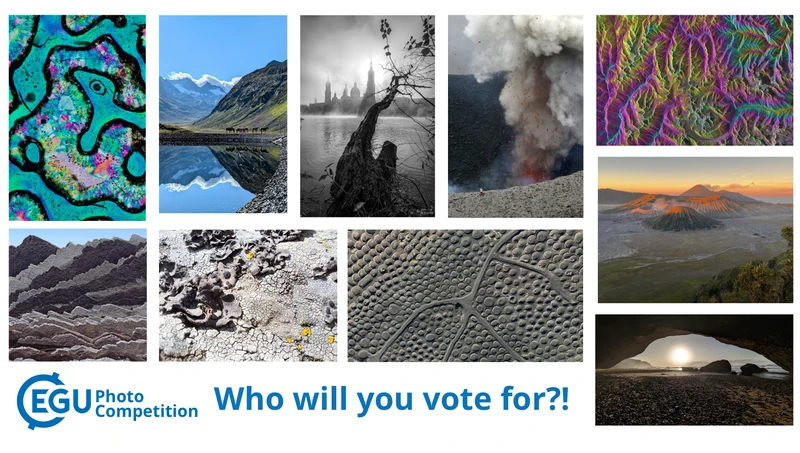
EGU26 Photo Competition – VOTING OPEN!
Voting has opened today for the sixteenth annual EGU Photo Competition! Ten creative and curious images were selected from 100’s of entrants for this year’s contest on the imaggeo website, in the hopes of being voted one of the top three photos of the year, awarding the winner with free registration to next year’s meeting. The winners are selected by you and voting is open until 20.00 (CEST) on Thursday 7 May. Winners are announced on Friday on the EGU blog, geolog.egu.eu, and at the EGU Booth in Hall X2.
Vote for your favourite.
Overlooked in models? The dynamics of terrestrial ecosystems and their coupled feedbacks on hydrology, biogeochemistry and geomorphology
Earth system models and associated finer resolution models are key tools for the simulation of the feedbacks and linkages between soil, hydrological, geomorphological, and ecosystem processes, and to simulate the water and energy balance and their interactions at different scales. However, there are important coupled feedbacks on the scale of years to decades missing in many terrestrial ecosystem models. Landscapes change and adapt to atmospheric forcing, changing climatic conditions and anthropogenic activities, leading to a changed hydrological behavior of the earth surface. These dynamics are not included in the larger scale hydrological models, nor discussed as critical. This Great Debate aims to raise awareness of the importance of these feedbacks and that soil is more than a parameter that can be considered static for models that are run for several decades, and additionally provide a dialogue between contrasting opinions on what is important to include in models.
GDB6: 10:45–12:30 (CEST) Room E1
Speleothem and karst records - Reconstructing terrestrial climatic and environmental change
Speleothems are key terrestrial archives of regional to global palaeoclimatic and palaeoenvironmental changes on sub-seasonal to orbital timescales. They provide high temporally resolved records which can be accurately and precisely dated using a variety of proxies, such as stable O and C isotopes and trace elements. Recent efforts have seen the rise in more non-traditional proxies such as fluid inclusion water isotopes, organic biomarkers, pollen, dead carbon fraction etc. This advancement towards quantitative reconstructions of past precipitation, temperature, or other environmental variables and climate patterns are key variables for data-model comparisons and evaluation. Beyond this, caves and karst areas additionally host an enormous suite of valuable proxy archives such as cave ice, cryogenic carbonates, clastic sediments, tufa, or travertine sequences, which complement the terrestrial palaeorecord, and are often associated with important fossils, historical or archaeological findings. This session aims to integrate recent developments in the field and invites submissions from a broad range of cave- and karst-related studies from orbital to sub-seasonal timescales.
CL1.2.3: Orals, 14:00–18:00 (CEST) Room F1, on site posters, 08:30–10:15 (CEST) Hall X5
Advances in computational modelling, data analysis, and visualisation in GMPV
The dynamics of magmatic systems are governed by complex, multiscale processes that span from melt generation in the mantle to magma transport, storage, and surface eruptions. These processes include fluid mechanics, thermodynamics, phase changes, and chemical and rheological interactions, which are coupled and operate over spatial scales from nanometres to kilometres and temporal scales from seconds to millions of years. At the same time, rapid advances in imaging, microscopy, and monitoring techniques are producing large, high-dimensional datasets across a wide range of scales and modalities. Visualisation and correlation methods are therefore becoming central to the modelling workflow, enabling meaningful comparisons between simulations, laboratory experiments, and natural observations, and facilitating the identification of patterns, structures, and emergent behaviour in complex magmatic systems. The session aims to provide a platform for in-depth technical exchange between researchers working on modelling, data analysis, and visualisation, strengthening links between computational, experimental, and observational communities within GMPV.
GMPV12.1: PICO: 16:15–18:00 (CEST) PICO spot 2
From Honest Brokers to Lobbyists: What Could Be the Role of Scientists in Different Contexts and Countries?
Across the globe, the pathways from scientific evidence to political action are anything but uniform. While some researchers are encouraged to engage directly in shaping national agendas, others operate in systems where science-policy boundaries are strictly delineated. Rather than asking what should be the role of scientists—a debate often limited by normative frameworks—this Science for Policy Great Debate asks: What could be the role of scientists in various governance and institutional contexts? The aim is to spark a forward-looking conversation on how scientists could engage across policy systems—acknowledging structural, cultural, and political diversity—and what mechanisms are needed to support that engagement sustainably. This Great Debate will also look ahead: What emerging structures and support systems are necessary to equip scientists with the tools, networks, mandates, incentives, and trust to work across science-policy boundaries? How can international collaboration respect national context while fostering shared ambition?
GDB4: 16:15–18:00 (CEST) Room E1
Exoplanets atmospheres: climates, clouds, magnetic fields and charge processes
This session brings together new developments in the characterisation of exoplanet climate regimes based on observations with, for example, JWST and CHEOPS and also new advances in theoretical modelling triggered by new observations. Smaller space telescopes like TESS and CHEOPS provide equally important insight into the physics of exoplanet atmospheres. While many processes have been predicted for exoplanets before they could be observed, planetary clouds and magnetic fields have been studied for solar system planets in situ with many space missions. This session is triggered by the upcoming PLATO launch at the end of 2026 and ongoing CHEOPS-PLATO synergies, including atmospheric characterization of hot to ultra-hot Jupiters facilitated by optical observations that are highly complementary to JWST observations in the infrared.
PS5.1: Orals 16:15–18:00 (CEST) Room 0.94/95, on site posters, Tue 5 May, 08:30–10:15 (CEST) Hall X4, virtual posters, Thu 7 May, 14:15–15:45 (CEST) vPoster spot 4
EGU Exhibition
Don’t miss out the EGU Exhibition where you will get a chance to talk with industry representatives and members of other academic, scientific and publishing organisations. Several of the Exhibitors are running special events throughout the week, check the Exhibition events portal for a range of events.
Today at the Open Science and Data Help Desk lunchtime sessions: Everyone has an ORCID iD, but how can you use it best? (Melanie Lorenz, GFZ Helmholtz Centre for Geosciences)
12:15 – 13:45 (CEST) Booth X207
Opening times of the Exhibition:
Monday, 4 May to Thursday, 7 May 2026: daily from 10:00 to 18:00 (CEST)
Friday, 8 May 2025: 10:00–13:00 (CEST)
List of Exhibitors
Meet EGU - at the EGU Booth in Hall X2 and the 25 years of interactive publishing booth in the Entrance Hall
Talk to the volunteers who make EGU happen; from giving out awards and funding, to making decisions about our publications and the General Assembly, come and Meet EGU!
- Meet the executive editors of Atmospheric Chemistry and Physics (25 years of interactive open-access publishing booth ): 13:45–14:45 CEST
- Meet the executive editors of Solid Earth (25 years of interactive open-access publishing booth ): 15:00–16:00 CEST
- Meet the Geomorphology division team (EGU booth ): 15:45–16:15 CEST
About
EGUtoday helps you keep up with the many activities at the General Assembly by highlighting sessions and events from the programme. If you have comments, email the editor Hazel Gibson at communications@egu.eu. The newsletter is available at https://www.egu.eu/egutoday/ and on the EGUapp.
The Assembly Online
LinkedIn
Instagram
YouTube
Facebook
Mastodon
Bluesky
blogs.egu.eu, geolog.egu.eu
www.egu.eu