|
The LOUPE
|
|
Issue 133, February 2026
|
|
|
The year-round resource for EGU members
|
|
|
Geoscience for the benefit of humanity and the planet
|
|
|
|
Credit: Jennifer Fatt
(Source)
|
|
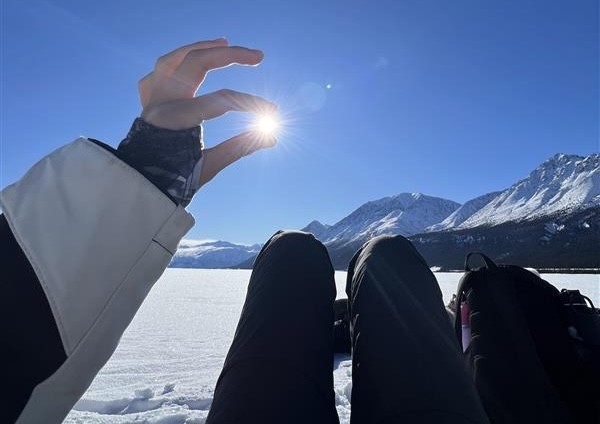
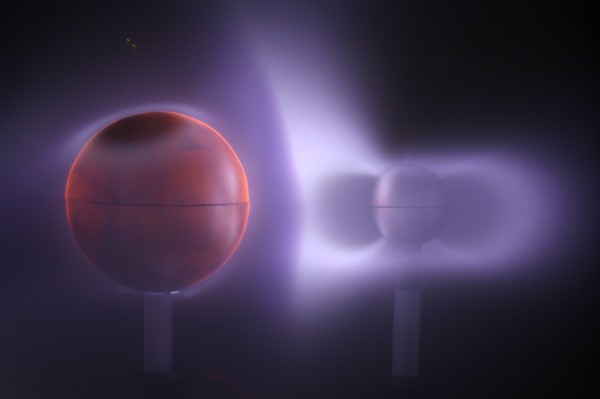
Science in extreme placesWhen researchers peer into unknown environmentsFrom the frozen expanse of Antarctica to the vacuum of space, this month EGU was hearing stories of science done in extreme places. We heard from Julia Martin, who on the 70th anniversary of the McMurdo base's installation, shares with a day in the life of a polar scientist, "Setting up our main measurements field fills my heart with joy as I see our scientific mission grow. Living on the sea ice is incredibly special. It is a unique, extreme, and challenging environment that reduces life to the bare minimum: eat, work, eat, sleep and repeat. ...Every ice-cold breath I take, I take with joy. And I realised not only what a privilege it is to be a snow scientist, but that it is what I was dreaming about growing up as a little girl." Asmae Ourkiya took us from the cold of Antarctica to the cold of space when they shared the story of how the Viking missions observed previously theoretical truths about space plasma, 40 years ago this month. But sometimes discover comes in a familiar place at an unexpected scale, as new Biogeosciences ECS Rep Elsa Abs explained when they shared their work on the behaviours of microbes in soils! On International Day of Women and Girls in Science, seismologist Simona Gabrielli shared some of the challenges and barriers that women and people of other genders face in the geosciences, and how she hopes things will continue to change. The recipients of the Teacher-Scientist Pairing Scheme in 2025 share their journey to creating a digital science lesson, and we also learned about the 24 training schools and member-organised conferences that EGU is funding in 2026! EGU26 is only two months away, so don't miss out on your Early-bird registration, which is open until 13:00 CEST 1 April 2026. You can also help to support your community at EGU26 by volunteering to our Peer Support programme that helps General Assembly novices navigate the meeting! Both novices and experienced attendees can now apply to take part by 31 March 2026. |
|
|
SCIENCE FOR POLICY
|
Pitch your research to a policymaker at EGU26If you’re attending EGU26 in person and would like to practice pitching your research to policymakers, you can submit your research topic or project here and join us from 10:45 - 12:30 CEST, Tuesday 5 May to give your pitch to a panel of science for policy experts! The timeslots will be allocated on a first-come, first-serve basis. After a short presentation on how researchers can effectively pitch (or present) their research to policymakers, these experts will listen to your pitch, give you feedback, and provide insights on areas of improvement. |
|
|
|
|
|
|
|
|
|
|
|
|
|
|
|
JOURNAL WATCH
|
|
|
Credit: Gabriel Voitcu
(Source)
|
"The present study provides an exposition of the negating effect that high conductivities can have for instability growth in the F-region ionosphere, where an electrodynamic description of the ionosphere at impact isolates the influence that conductance demands over ambipolar diffusion in a plasma rich in ion-neutral collisions (roughly 90–150 km altitude). We show that when ionization sources cease and conductance is nominally low and decreasing, the structuring of F-region plasma responds in predictable ways, increasing in occurrence and magnitude." Iverson (2026) A source or a sink? How the altitude of particle precipitation influence high-latitude electrodynamics Annales Geophysicae |
|
|
|
ANNOUNCEMENTS
|
EGU thanks our 12,000 volunteers who gave their time in 2025EGU want to share our thanks with the over 12,000 volunteers who gave their time in 2025. President Peter van der Beek commented "Despite the trying times of the last few years, I'm excited to see what 2026 will hold for EGU and our members, I cannot express how grateful I am to be a part of this dedicated and curious community. Thank you all!” Read his full message here. |
|
EGUwebinar: Mental health in academia- obstacles, advocacy and inclusionHow can academics create more inclusive and balanced working environments in the face of a growing mental health crisis? Watch this EGUwebinar with EGU's BG Division President Ana Bastos to learn more. |
|
|
UPCOMING DATES
|
EGU Science for Policy HangoutCome virtually network with those working at the science-policy interface! Register for our next #Sci4Pol Hangout at 14:00 CET on Monday 2 March. |
JOB VACANCY: Executive Assistant at EGU Executive OfficeEGU is currently seeking a full-time, permanent Executive Assistant, to be based in the Executive Office in Munich, Germany to support the work of the Executive Director, read the full position details here. Applications will be reviewed from 12:00 (CET) 23 March until the position is filled. |
EGUwebinar: How to get a European postdoctoral grantLooking for support and encouragement in your application for European postdoctoral grants? From individual stories to advice on the process of getting funded, join this special EGUwebinar on 11 March at 17:00 CET to learn how you can use postdoctoral grants to advance your career. Register today! |
EGUwebinar: Climate of the Past 20th Anniversary: Past volcanism and climateStudying the response to past volcanic activity helps to quantify the impact of short term forcing on global climate and to test the ability of climate models to reproduce this impact. This webinar is part of a special series celebrating 20 years of Climate of the Past, an interactive journal of the European Geosciences Union. As part of a special series celebrating 20 years of EGU journal 'Climate of the Past', join this EGUwebinar at 16:00CET, 18 March to hear leaders in the field address these ideas. Register here today. |
Help new attendees of EGU26 by volunteering to offer Peer SupportIf you have attended the EGU General Assembly before you know how confusing it can be for new people. Why not offer your help by volunteering to give a little Peer Support during the week of the meeting. Applications for experienced and novice attendees are now open - submit your application by 31 March 2026 and help everyone in the EGU community feel welcome! |
|
EGU BLOGS
|
Geolog, the Union’s official blog |
|
|
Cryospheric Sciences Division blog |
|
|
Geolog, the Union’s official blog |
|
|
Solar-Terrestrial Sciences Division blog |
|
|
Cryospheric Sciences Division blog |
|
|
Natural Hazards Division blog |
|
|
Geolog, the Union’s official blog |
|
|
Hydrological Sciences Division blog |
|
|
Nonlinear Processes in Geosciences Division blog |
|
|
©2026 European Geosciences Union.
All rights reserved.
|
|
Our mailing address is:
EGU - European Geosciences Union e.V.
Kastenbauerstr. 2
81677 Munich, Germany
|
|
|
|
|