President: Kerstin Treydte
(Emailcl@egu.eu)
Deputy President: Gabriele Messori
(Email)
ECS Representative: Valeria Mascolo
(Emailecs-cl@egu.eu)
The Division on Climate: Past, Present & Future (CL) is one of the larger divisions of the European Geosciences Union. It pools from many disciplines and consequently has many co-organised sessions with other divisions at the EGU General Assembly. The division is very interdisciplinary and covers climate variations on all time scales. CL includes the study of any kind of climate archive from rocks to ocean cores, speleothems, ice cores, chronicles, to instrumental records to name a few. Besides observations, climate modelling on all time scales from the deep past to the future are areas covered by the division. Any aspect of the climate system falls into the realm of the division e.g. atmosphere, ocean, biosphere, cryosphere, and geology. Themes focus on the climate on Earth but may also expand other planets or the Sun.
Latest posts from the CL blog
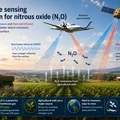
A Remote Sensing Solution for Nitrous Oxide: The Greenhouse Gas We Need to See Better
When we talk about greenhouse gases and climate change, carbon dioxide (CO2) and methane (CH4) usually receive most of the attention. Yet another gas, nitrous oxide (N2O), quietly plays an important role in our changing climate. Commonly known as “laughing gas”, N2O is a powerful greenhouse gas with nearly 273 times the warming potential of CO2 over a 100-year period. Once released, it can remain in the atmosphere for more than a century. During this time, it contributes not only …
Read more
When ozone enters a leaf: why the details matter for Earth system models
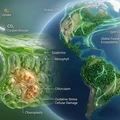
(Schematic cross-section showing leaf stomatal O_3 uptake, chloroplast oxidative stress, and the resulting downregulation of Earth’s global photosynthetic carbon uptake (GPP)) We usually think of ozone as a shield high in the atmosphere or as an air pollutant that harms human lungs near the ground. But plants also “breathe” ozone. Through microscopic pores called stomata, leaves take in carbon dioxide for photosynthesis—and ozone can enter through the same doorway. Once inside a leaf, ozone forms reactive compounds that disrupt photosynthesis …
Read more

Challenges in accessibility and code quality of the climate models that underpin our understanding of climate change
Climate models help us understand how the climate system works, project future climate change, and provide evidence that supports international assessments such as exposed on the IPCC. At this point, there is a fundamental question that is rarely discussed and solved: Can we access and reproduce the climate models used throughout the history of the Coupled Model Intercomparision Project (CMIP)? In our recent study, we explored this question by assessing the accessibility and software quality of climate models that participated …
Read more
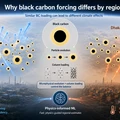
Why the Same Soot Can Warm One City and Cool Another
Every time something burns incompletely —whether in a car engine, a factory furnace, a cooking fire, an agricultural field set alight after harvest, or a vast wildfire sweeping through savanna grasslands— tiny particles of black carbon are released into the atmosphere. You might know these more simply as soot. These particles are so small that thousands of them laid side by side would barely stretch across the width of a human hair. Yet despite their minuscule size, black carbon (also …
Read more
Recent awardees

The 2026 Hans Oeschger Medal is awarded to
Friederike E.L. Otto for pioneering extreme event attribution and transforming climate communication through the World Weather Attribution initiative.
Read more

- 2026
- Division Outstanding Early Career Scientist Award
The 2026 Division Outstanding Early Career Scientist Award is awarded to
Marlow Julius Cramwinckel for innovative contributions to the combination of climate reconstructions and modelling to constrain climate, carbon cycle, and hydrological feedbacks in the past.
Read more
The 2025 Hans Oeschger Medal is awarded to
Heather Marie Stoll for pioneering contributions in both marine and terrestrial palaeoclimate research, which led to groundbreaking advancement in our understanding of rapid climate change, through forcings and feedbacks.
Read more

- 2025
- Milutin Milanković Medal
The 2025 Milutin Milanković Medal is awarded to
Zhengyu Liu for outstanding contributions to our understanding of global climate change by combining theoretical approaches, the development and use of a hierarchy of models, and model-data comparisons.
Read more

- 2025
- Division Outstanding Early Career Scientist Award
The 2025 Division Outstanding Early Career Scientist Award is awarded to
Kai Kornhuber for outstanding research on extreme weather and climate dynamics, including circumglobal patterns in the jet stream, their relation to heatwaves and food security, and representation in climate models.
Read more

- 2025
- Outstanding Student and PhD candidate Presentation (OSPP) Award
The 2025 Outstanding Student and PhD candidate Presentation (OSPP) Award is awarded to
Devika Moovidathu Vasudevan Upper Tropospheric Humidity and Cloud Radiative Forcing: A Tropical Perspective
Read more

- 2025
- Outstanding Student and PhD candidate Presentation (OSPP) Award
The 2025 Outstanding Student and PhD candidate Presentation (OSPP) Award is awarded to
Lison Soussaintjean Towards understanding the N2O production in dust-rich Antarctic ice
Read more
- 2025
- Outstanding Student and PhD candidate Presentation (OSPP) Award
The 2025 Outstanding Student and PhD candidate Presentation (OSPP) Award is awarded to
Ramona Schneider Magnetic fabric of Tajik loess-palaeosols as a palaeowind and process indicator
Read more

- 2025
- Outstanding Student and PhD candidate Presentation (OSPP) Award
The 2025 Outstanding Student and PhD candidate Presentation (OSPP) Award is awarded to
Tatiana Bebchuk Subfossil yew (Taxus baccata) wood from eastern England reveals mid-Holocene climate and environmental changes
Read more
Current issue of the EGU newsletter
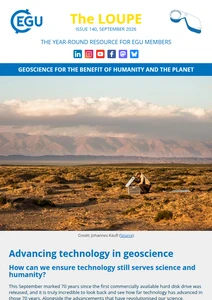
In our September issue, we ask whether our accelerating technological advancement is still serving science (and scientists), and hear from the incoming Early Career Scientist rep for the Geosciences Instrumentation and Data Systems (GI) Division Luigi Bianco. Don't miss your chance to register for one of our autumn workshops the Outreach Committee is seeking a consultant to help develop a mentoring programme.
All this and much more, in this month's Loupe!
Read more