|
The LOUPE
|
|
Issue 139, August 2026
|
|
|
The year-round resource for EGU members
|
|
|
Geoscience for the benefit of humanity and the planet
|
|
|
|
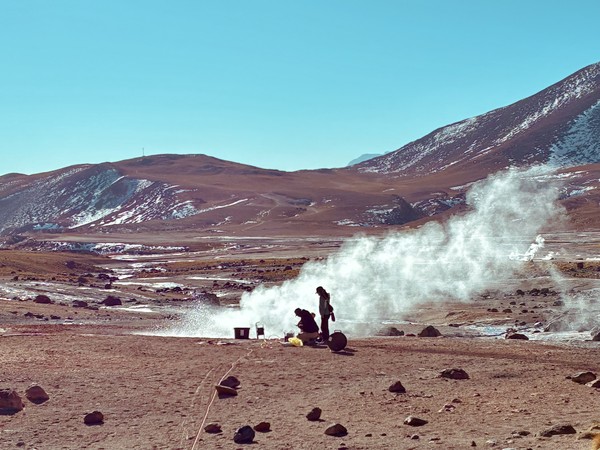
Credit: Wouter Deleersnyder
(Source)
|
|
The legacy of disasters we are still learning fromHow scientists race to better understand and prepare for natural hazardsIn recent days we watched the unfolding disaster in Nepal with shock and sadness. During such a time, many researchers will be reminded of awful disasters in their own fields or experiences, or perhaps closer to home, such as the devastating Lake Nyos limnic eruption in Cameroon or the terrible Biescas flooding in Spain, both examined on the EGU Geolog this month as we look back over the 30 or 40 years since those disasters occurred. One thing that remains clear from both events, is that no matter the hazard that triggered that disaster, scientists in both cases worked hard and fast to try to understand that hazard and mitigate against future risks as best they could. The other thing that is evident is how individual each disaster was and the importance of researchers collaborating across various field to help protect people and livelihoods. EGU Natural Hazards Division ECS representative Elisa Nobile also spoke with us earlier this month, about her research on the socio-economic impacts of floods, identifying one area the field could advance, "I think we should look at events at the scale where they really happen, which is often larger than one river basin or one country... If each basin and each country assesses its losses separately, we lose the picture of the whole event. We also lose the interactions, because emergency teams and reconstruction capacity are requested everywhere at once, and economic effects travel across borders through transport and supply chains. So we need assessments that treat such an event as one single event." Read more in her interview. We are now accepting proposals for sessions, Geopanels (formerly Union Symposia or Great Debates) and short courses for EGU27 by 23 September 2026. Finally don't forget to nominate candidates for the Treasurer and Union representative of the Early Career Scientists for the Autumn Elections, by 8 September. |
|
|
SCIENCE FOR POLICY
|
Final call for EGU's 2026 Science-Policy Pairing SchemeIf you’re curious about science for policy and would like to experience life inside the European Parliament, then don’t miss your chance to apply for the 2026 EGU Science-Policy Pairing Scheme! We are pleased to announce that this year’s pairing will be with Dimitris Tsiodras, a Member of the European Parliament. The successful applicant will go to Brussels 3-6 November 2026. You can read more about the Pairing Scheme here and learn about the experiences of previous Pairing Scheme participants here. Submit your application form, attaching a CV (max 1-page) and a cover letter outlining your motivation for participating in the Pairing Scheme, by midnight on 1 September 2026. |
Join September's Science for Policy HangoutDon't miss next month's Science for Policy Hangout at 14:00 CEST on Monday 7 September, with Eleni Zika, the Head of Sector for Scientific Impact and Feedback to Policy at the European Research Council. Eleni will share her experiences and the activities of the Feedback to Policy Sector, including their impact on European policy and their work on frontier research. There will also be time for participants to ask questions and virtually mingle. Register here. |
|
|
|
|
|
|
|
|
|
JOURNAL WATCH
|
|
|
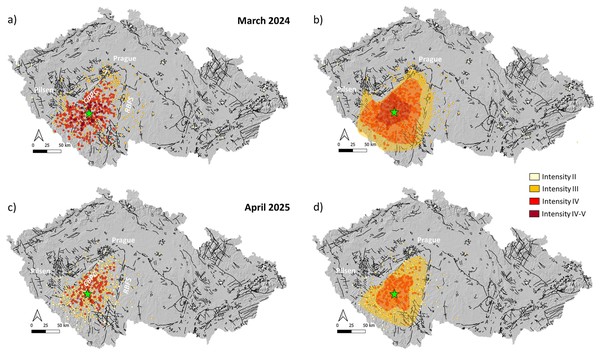
The Mirotice earthquakes. (a, b) ML 3.5 event in March 2024; (c, d) ML 3.1 event in April 2025. (a, c) Spatial distribution of macroseismic observations (b, d) macroseismic intensity (Read full caption in paper) |
"Despite occurring in a region generally considered seismically non-active and characterized by relatively low population density, both earthquakes attracted significant public attention, resulting in a high number of completed questionnaires. The uneven spatial pattern of macroseismic observations, which was not controlled by population density, proved highly informative and showed a clear correlation with major geological structures." Hrubcová et al (2026) Public response to two rare earthquakes: crowdsourcing constraints on crustal structure in south Bohemian Massif Solid Earth |
|
|
|
ANNOUNCEMENTS
|
EGU's Outreach Committee seeks new volunteer members!EGU's Outreach Committee, which focuses on public engagement activities, communication between scientists and students, and supporting the training and development of budding science communicators, is seeking THREE new volunteer members to help direct the Union's Outreach and Science Communication activities over the next few years. Check the requirements and apply to join by 28 September. |
|
EGUwebinar: Introducing Project CosmosKeeping track of new publications in climate science can be a very difficult task, but now Carbon Brief has developed the world’s largest database of climate change research: Cosmos. Learn more on our YouTube channel. |
|
|
UPCOMING DATES
|
EGU Science for Policy HangoutCome virtually network with those working at the science-policy interface! Register for our next #Sci4Pol Hangout at 14:00 CEST on Monday 7 September. |
|
|
EGU 2026 workshops: science communication and ECS career development!Each year EGU Committees sponsor professional workshops in a range of subjects that are FREE for EGU members to attend. This year we have six workshops (one of which is already fully booked so not included on this list), so choose the one that interests you and register now! Beyond pretty pictures; the art (and science of designing engaging graphics) with author-illustrator and science communicator Lucía Perez-Díaz, 7, 14, 21 and 28 October, 13:00-14:00 CEST. Read more and register here. Lights, camera, geoscience with geoscience communication consultant Sérgio Esperancinha at Four.Six, 3, 10, 17 and 24 November, 15:00-16:30 CET. Read more and register here. Navigating your research career - strengths, strategy and sustainability with researcher career development specialist Naomi Tyrrell, 4, 11, 18 and 25 November, 16:00-17:30 CET. Read more and register here. Beyond attendance; an introduction to evaluation and assessment of informal science learning with STEM education researcher Gregory Goldsmith, 5 and 12 November, 16:00-17:30 CET. Read more and register here. Presenting with impact; engaging public audiences in Earth, planetary and space science with science communicator Emma Donnelly at Comm-it, 30 November, 7 and 14 December, 09:30-11:00 CET. Read more and register here. |
|
EGU BLOGS
|
Geolog, the Union’s official blog |
|
|
Natural Hazards Division blog |
|
|
Geolog, the Union’s official blog |
|
|
|
|
|
|
Hydrological Sciences Division blog |
|
|
Geochemistry, Mineralogy, Petrology & Volcanology Division blog |
|
|
Geolog, the Union’s official blog |
|
|
|
|
|
|
Geolog, the Union’s official blog |
|
|
|
|
©2026 European Geosciences Union.
All rights reserved.
|
|
Our mailing address is:
EGU - European Geosciences Union e.V.
Kastenbauerstr. 2
81677 Munich, Germany
|
|
|
|
|