President: Philip Stier
(Emailas@egu.eu)
Deputy President: Andrea Pozzer
(Email)
ECS Representative: Mozhgan Amiramjadi
(Emailecs-as@egu.eu)
The Atmospheric Sciences (AS) Division is one of the largest divisions of the European Geosciences Union. The research areas covered by the division extend from the large-scale dynamical/meteorological processes and systems in the atmosphere (like cyclones and global atmosphere circulation) to the small scale turbulent mixing, they cover the time frame from centuries (in connection with climate research) to seconds (in the context of fast chemistry). Atmospheric sciences include studies of the atmosphere composition, aerosol and cloud physics, gas-particles interactions and chemical reaction kinetics studied in the labs.
Latest posts from the AS blog
Are we valuing poster sessions enough?
Do not get me wrong, EGUs General Assembly is a great conference and it’s a real pleasure to explore all the science on display, reconnect with colleagues from other institutes, cities and disciplines. But, wandering the venue and seeing all the empty poster walls left a sad feeling. It’s not only singular gaps in an otherwise packed hall, it’s whole empty corridors and not only Monday morning or Friday afternoon. One might ask themselves, if that’s a symptom of how …
Read more
The Invisible Chemistry of Life: Jonathan Williams and the Language of the Air Around Us
Prof. Jonathan Williams is an atmospheric chemist at the Max Planck Institute for Chemistry in Mainz, Germany, where he leads research into volatile organic compounds — the invisible molecules emitted by forests, cities, people, and everything in between. His work spans the Amazon rainforest to cinema audiences, from elderflower blossoms to the breath of cities. Chemist by Chance, Then by Choice Jonathan Williams never sat down and decided to become a chemist. It happened gradually, as it often does — …
Read more
CLOUDLAB: Cloud research in a natural laboratory
It’s murky grey, windy, and freezing when we head out into the countryside of the Swiss pre-Alps. We are looking for low hanging clouds to serve as our natural laboratory. Wintertime low stratus clouds can cover Switzerland for days. This type of cloud is stable with temperatures below 0 ºC and it contains plenty of liquid cloud droplets, but no ice crystals. These are the perfect background conditions for starting our experiments (see Figure 1, left). We launch an uncrewed …
Read more
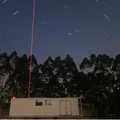
China’s Hainan Unlocks Mysteries of Heat and Sodium Transport 80–100 km Above Earth
When we gaze at the sky, our eyes often linger on blue horizons, floating clouds, or twinkling stars—rarely do we think about the critical processes unfolding 80 to 100 km above ground. This region, known as the mesopause, acts as a vital transition zone for aviation and aerospace activities (not vital for routine commercial aviation, but it is indispensable for high-altitude aerospace, experimental aviation, spacecraft re-entry/launch, and the broader atmospheric models that underpin all aviation operations), where subtle changes in …
Read more
Recent awardees
- 2026
- Vilhelm Bjerknes Medal
The 2026 Vilhelm Bjerknes Medal is awarded to
Jonathan Williams for leading, significant and sustained contributions to our understanding of volatile organic compounds, in the outdoor and indoor atmosphere.
Read more

- 2026
- Division Outstanding Early Career Scientist Award
The 2026 Division Outstanding Early Career Scientist Award is awarded to
Eva Pfannerstill for contributions to atmospheric chemistry, in particular to our understanding of the reactivity of hydroxyl radicals (OH) and ozone formation.
Read more

- 2025
- Vilhelm Bjerknes Medal
The 2025 Vilhelm Bjerknes Medal is awarded to
Ulrike Lohmann for outstanding research on cloud-climate interactions; integrating microscale processes and satellite data with global models to assess the radiative effects of clouds on the Earth system.
Read more

- 2025
- Division Outstanding Early Career Scientist Award
The 2025 Division Outstanding Early Career Scientist Award is awarded to
Dominik Stolzenburg for innovative contributions and dedication to the fields of atmospheric chemistry and physics, particularly in the areas of new particle formation and nanoparticle growth.
Read more

- 2025
- Outstanding Student and PhD candidate Presentation (OSPP) Award
The 2025 Outstanding Student and PhD candidate Presentation (OSPP) Award is awarded to
Andrina Caratsch Will tropical cyclones weaken in a cleaner environment? Composite perspective on ICON ensemble simulations with prescribed aerosols
Read more

- 2025
- Outstanding Student and PhD candidate Presentation (OSPP) Award
The 2025 Outstanding Student and PhD candidate Presentation (OSPP) Award is awarded to
Claudia Schiavini Concentration fluctuations and risk estimation on industrial sites
Read more

- 2025
- Outstanding Student and PhD candidate Presentation (OSPP) Award
The 2025 Outstanding Student and PhD candidate Presentation (OSPP) Award is awarded to
Donghee Lee Spatiotemporal pattern analyses of AOD and NO2 VCD in Southeast Asian countries using low-Earth and geostationary orbit satellite data
Read more

- 2025
- Outstanding Student and PhD candidate Presentation (OSPP) Award
The 2025 Outstanding Student and PhD candidate Presentation (OSPP) Award is awarded to
Felix Goddard Airborne microplastic radiative effects: a sensitivity study
Read more

- 2025
- Outstanding Student and PhD candidate Presentation (OSPP) Award
The 2025 Outstanding Student and PhD candidate Presentation (OSPP) Award is awarded to
Sara M. Vallejo-Bernal Atmospheric Rivers as Interacting Elements of the Earth System: A Complexity Science Perspective
Read more

- 2025
- Outstanding Student and PhD candidate Presentation (OSPP) Award
The 2025 Outstanding Student and PhD candidate Presentation (OSPP) Award is awarded to
Yi Xiao VAE-Var: Variational Autoencoder-Enhanced Variational Methods for Data Assimilation
Read more

- 2025
- Outstanding Student and PhD candidate Presentation (OSPP) Award
The 2025 Outstanding Student and PhD candidate Presentation (OSPP) Award is awarded to
Yotam Menachem Exploring Forest-Atmosphere Interactions Under Heat Extremes in a Semi-Arid Region
Read more
Current issue of the EGU newsletter
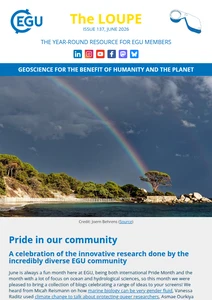
In our June issue, it's Pride Month and we dive into new discoveries for estuarine mixing and hydrological process modelling. A guide to accessing support for EU-based researchers is available on our YouTube channel and don't miss your chance to join our free EGU peer review training!
All this and much more, in this month's Loupe!
Read more