
Benjamin Bomfleur
- 2026
- Jean Baptiste Lamarck Medal
The 2026 Jean Baptiste Lamarck Medal is awarded to Benjamin Bomfleur for excellence in palaeobotany, specifically on the evolution, taxonomy and palaeobiology of plants.

European Geosciences Union
Division on Stratigraphy, Sedimentology and Palaeontology
President: Cinzia Bottini
(Emailssp@egu.eu)
Deputy President: Mónica Sánchez-Román
(Email)
ECS Representative: Shradha Menon
(Emailecs-ssp@egu.eu)
The Stratigraphy, Sedimentology and Palaeontology Division (SSP) focuses its activities on all aspects of the sedimentary record. About 70% of the Earth surface is covered by sedimentary deposits, which are eroded and deposited right at the contact between the solid lithosphere and the atmosphere, biosphere and hydrosphere. Sedimentary rocks record the history of our planet since almost 4 billion of years and play a pivotal role for our understanding of the evolution of life. This deep-time archive of Earth history is studied with a wide range of analytical techniques providing ever stunning details on the evolution of our planet. Sedimentary basins host important natural resources like coal, gas, oil, ore deposits and groundwater and therefore a better understanding of the physical, chemical and biological processes controlling the formation and distribution of sediments and sedimentary rocks is of utmost importance for our society.
The 2026 Jean Baptiste Lamarck Medal is awarded to Benjamin Bomfleur for excellence in palaeobotany, specifically on the evolution, taxonomy and palaeobiology of plants.

The 2026 Division Outstanding Early Career Scientist Award is awarded to Matthias Sinnesael for advancing open and reproducible cyclostratigraphy through innovative research, community-building, and fostering the next generation of stratigraphers.
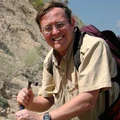
The 2025 Jean Baptiste Lamarck Medal is awarded to Donald Ross Prothero in recognition of a strong research profile in terrestrial stratigraphy, and unwavering support and education of the next generation.

The 2025 Outstanding Student and PhD candidate Presentation (OSPP) Award is awarded to Zsanett Szilagyi Subsurface dissection of Holocene inter-reef Halimeda bioherms: morphology, facies and latitudinal variations in the northern Great Barrier Reef
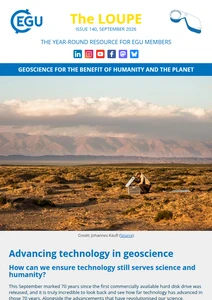
In our September issue, we ask whether our accelerating technological advancement is still serving science (and scientists), and hear from the incoming Early Career Scientist rep for the Geosciences Instrumentation and Data Systems (GI) Division Luigi Bianco. Don't miss your chance to register for one of our autumn workshops the Outreach Committee is seeking a consultant to help develop a mentoring programme.
All this and much more, in this month's Loupe!