President: Laetitia Le Pourhiet
(Emailgd@egu.eu)
Deputy President: Boris Kaus
(Email)
ECS Representative: Constanza Rodriguez Piceda
(Emailecs-gd@egu.eu)
Studies related to the Geodynamics Division include all aspects of geodynamic processes in the lithosphere, mantle, and core. They encompass different approaches, including observations, imaging, theory, modelling (numerical simulations and laboratory experiments), and interpretation. Examples include the dynamics of subduction, mid-ocean-ridge processes, vertical and horizontal plate movements driving mountain building and basin formation, lithosphere dynamics, mantle convection, and core dynamics.
Latest posts from the GD blog
The giant seafloor sponge: how water ends up in subducting crust
In this week’s blog post, Daniel Douglas teaches us everything about poroelasticity, water in subduction zones and… sponges under the sea! Are you ready kids? Aye, aye, Captain! Why study subduction zones? “Subduction” is a process that occurs when two tectonic plates collide with each other. As long as one of the plates is an “oceanic plate”, then the denser of the two tectonic plates will be pushed under the less dense plate and subduction will occur. This phenomenon occurs …
Read more

The Sassy scientist – Where are disabled geologists?
Dear Sassy Scientist, In my institute I never see any disabled people. Only one or two people in wheelchair at the EGU GA. Considering the statistics in the global population, I’m sure some people are impared, but tell me : Where are the disabled geologist ? Is it impossible to be disabled and geologist ? Your gnocchie Dear gneiss human, Thank you for putting light on this question. To answer I need to be a bit serious and forget partly …
Read more

Beyond ‘black and white’: rethinking continental drift and land bridges through plate tectonics and orogenic bridges
In this essay, Jean-Baptiste Koehl reflects on the origin of a 100-year-old divide within the geoscience community and explores how tectonics and paleontology may be brought closer together through the concept of orogenic bridges. Disclaimer: The reflections presented here reflect my perspective grounded in my own research and experience. One of the most iconic interdisciplinary achievements in the geosciences is the integration of the fossil record, igneous and sedimentary rock units, fold-and-thrust belts, and even past glaciations on continents now …
Read more

Bridging the Gap: How Virtual Reality is Helping the Next Generation of Geoscientists
Deciphering Earth’s geological history is no easy feat. For undergraduate students beginning their journey in geology, identifying a rock and drawing connections with relevant geodynamic processes occurring over millions of years can be a challenge. In this week’s blog post, Phillip Ruscia explains how virtual reality (VR) and the High Immersion Virtual Experiences (HIVE) research lab at the University of Toronto are bridging the “abstraction gap” and preparing the next generation of geoscientists. Geodynamic processes span millions of years and …
Read more
Recent awardees
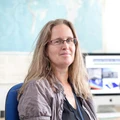
The 2026 Augustus Love Medal is awarded to
Saskia Goes for outstanding contributions to our understanding of Earth structure and evolution, using integrative research at the confluence of geodynamics, seismology, mineral physics, and geochemistry.
Read more

- 2026
- Division Outstanding Early Career Scientist Award
The 2026 Division Outstanding Early Career Scientist Award is awarded to
Siavash Ghelichkhan for pioneering the use of adjoint methods in geodynamics and developing open-source tools that integrate geodynamic models with observational data to improve understanding of Earth’s interior.
Read more

The 2025 Augustus Love Medal is awarded to
Neil M. Ribe for outstanding and fundamental contributions to a wide range of geodynamical problems using rigorous mathematical approaches.
Read more

- 2025
- Division Outstanding Early Career Scientist Award
The 2025 Division Outstanding Early Career Scientist Award is awarded to
Iris van Zelst for a profound impact on the geodynamics community through outstanding scientific contributions, inspiring leadership, enthusiastic outreach, and fostering an inclusive and diverse work environment.
Read more

- 2025
- Outstanding Student and PhD candidate Presentation (OSPP) Award
The 2025 Outstanding Student and PhD candidate Presentation (OSPP) Award is awarded to
Berta Vilacís Tracking dynamic topography through hiatus surfaces
Read more

- 2025
- Outstanding Student and PhD candidate Presentation (OSPP) Award
The 2025 Outstanding Student and PhD candidate Presentation (OSPP) Award is awarded to
Charlotte Gaugne Gouranton GRACE observations of rapid mass variations at the core-mantle boundary during deep mantle phase transitions in interaction with core flow
Read more
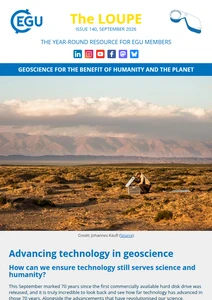
Current issue of the EGU newsletter
In our September issue, we ask whether our accelerating technological advancement is still serving science (and scientists), and hear from the incoming Early Career Scientist rep for the Geosciences Instrumentation and Data Systems (GI) Division Luigi Bianco. Don't miss your chance to register for one of our autumn workshops the Outreach Committee is seeking a consultant to help develop a mentoring programme.
All this and much more, in this month's Loupe!
Read more
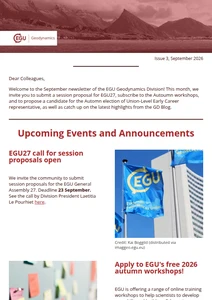
Current issue of the GD division newsletter
In this month's newsletter, you'll find the invitation to submit a session proposal for EGU27, subscribe to the Autumn workshops, and to propose a candidate for the Autumn election of Union-Level Early Career representative, as well as catch up on the latest highlights from the GD Blog.
Read more