President: Ana Bastos
(Emailbg@egu.eu)
Deputy President: Eliane Gomes-Alves
(Email)
ECS Representative: Rebecca Varney
(Emailecs-bg@egu.eu)
The Division on Biogeosciences integrates biological, chemical, and physical sciences dealing with processes and interactions within terrestrial and extraterrestrial realms through the current and earlier geological history of Earth and solar system in general. Its focus is beyond the established scientific approaches embracing multi- and interdisciplinary understandings of the biosphere functioning in space and time. In this division, we encourage the participation of scientists across different disciplines, including researchers from the field of applied biogeosciences as well as industrial professionals. Experimental, conceptual, and modelling approaches are welcome.
Latest posts from the BG blog
A paper that shaped my career – Tim Eglinton on Hayes et al., 1990
In this series, we ask senior researchers to reflect on how a paper or a series of contributions influenced their thinking and led to a change in their research direction and career. Our first reflection comes from Prof. Tim Eglinton, who was professor of Biogeoscience at the Department of Earth and Planetary Sciences of ETH Zurich, Switzerland until his recent retirement in 2025. Throughout his career, Tim has focused on understanding processes that govern the Earth’s carbon cycle and quantifying …
Read more
Five ways to improve your interdisciplinary communication skills
Oh, but you should know that… It is a short sentence, often spoken with good intentions. Yet in interdisciplinary conversations, it can bring a discussion to a complete halt. The moment someone says, “Oh, but you should know that,” they assume that what is obvious in their discipline must be obvious to everyone else. Hearing this phrase repeatedly in scientific discussions made me realise how much harder than what we often anticipate interdisciplinary communication may be. The challenge is not …
Read more
The beauty of Soil!
The Life Beneath Our Feet Where would we be without healthy soil? A lot of our research live would be in turmoil I’m here today to spread some soil appreciation, Which may require some thought transformation. Soil Is the base of our beautiful landscapes, Often where we go for some restorative escapes, Some key reasons to save soils from destruction They support 95% of global food production, And act as a filter for water purification, Don’t forget it’s major role …
Read more

Meet Thomas S. Bianchi, Vladimir Ivanovich Vernadsky Medallist 2026
Thomas S. Bianchi is the 2026 Vladimir Ivanovich Vernadsky medallist of the Biogeosciences Division. The BG team congratulates Thomas and celebrates this well deserved recognition! We talked with Thomas to learn more about his career, research interests and advice for early career scientists Could you tell us a bit about yourself and what inspired you to pursue a career in biogeosciences? I grew up in a blue-collar family in Holbrook, NY—then a one–traffic-light town on eastern Long Island surrounded by …
Read more
Recent awardees

- 2026
- Vladimir Ivanovich Vernadsky Medal
The 2026 Vladimir Ivanovich Vernadsky Medal is awarded to
Thomas Stephen Bianchi for fundamental contributions to understanding the carbon cycle in aquatic ecosystems at the nexus of rivers, estuaries, and coastal oceans.
Read more

- 2026
- Division Outstanding Early Career Scientist Award
The 2026 Division Outstanding Early Career Scientist Award is awarded to
Anne Klosterhalfen for outstanding contributions to improve measurements and understanding of ecosystem carbon and water fluxes, engagement in collaborative research, and dedication to education and outreach.
Read more

- 2025
- Vladimir Ivanovich Vernadsky Medal
The 2025 Vladimir Ivanovich Vernadsky Medal is awarded to
Corinne Le Quéré for development of research demonstrating the role of the oceans in the changing global carbon cycle, and leadership in the Global Carbon Project.
Read more

- 2025
- Division Outstanding Early Career Scientist Award
The 2025 Division Outstanding Early Career Scientist Award is awarded to
Getachew Agmuas Adnew for exceptional scientific contribution to the biogeosciences, developing breakthrough techniques to improve our understanding of greenhouse gas exchange between the biosphere and atmosphere.
Read more

- 2025
- Outstanding Student and PhD candidate Presentation (OSPP) Award
The 2025 Outstanding Student and PhD candidate Presentation (OSPP) Award is awarded to
Gukailin Ao Linking root phosphatase activity to root chemical and morphological traits across species: a global analysis
Read more

- 2025
- Outstanding Student and PhD candidate Presentation (OSPP) Award
The 2025 Outstanding Student and PhD candidate Presentation (OSPP) Award is awarded to
Laure Moinat Development of a new biogeodynamical tool for exploratory climate modelling
Read more

- 2025
- Outstanding Student and PhD candidate Presentation (OSPP) Award
The 2025 Outstanding Student and PhD candidate Presentation (OSPP) Award is awarded to
Nathalie Heldwein A novel method for the extraction and measurement of hydroxylamine (NH2OH) in soils
Read more

- 2025
- Outstanding Student and PhD candidate Presentation (OSPP) Award
The 2025 Outstanding Student and PhD candidate Presentation (OSPP) Award is awarded to
Paulina Englert A 2.5-Year Eddy Covariance Study of Nitrous Oxide Fluxes in Winter Barley, Sugar Beet and Winter Wheat: Responses to Environmental and Management Factors
Read more

- 2025
- Outstanding Student and PhD candidate Presentation (OSPP) Award
The 2025 Outstanding Student and PhD candidate Presentation (OSPP) Award is awarded to
Shekhar Goyal Towards Disentangling Environmental Costs of India's Agricultural Trade Network
Read more
Current issue of the EGU newsletter
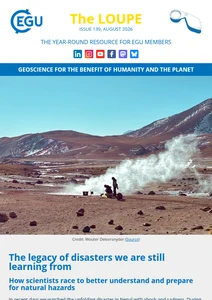
In our August issue, we reflect on the lessons learned from past disasters associated with natural hazards, and hear from the Early Career Scientist rep for the Natural Hazards Division Elisa Nobile. Don't miss your chance to register for one of our six autumn workshops and applications are open to volunteer with the Outreach Committee. The call for sessions for EGU27 is open and don't miss your chance to nominate someone to be the Union's next Early Career Scientist (ECS) Union-wide Representative or Treasurer!
All this and much more, in this month's Loupe!
Read more
Current issue of the BG division newsletter
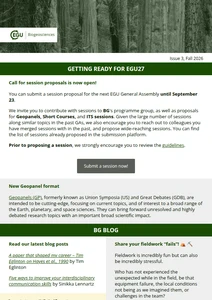
The EGU27 call for session proposals is open. Read our latest blog posts. EGU relevant dates and activities.
Read more