President: Laetitia Le Pourhiet
(Emailgd@egu.eu)
Deputy President: Jeroen van Hunen
(Email)
ECS Representative: Garima Shukla
(Emailecs-gd@egu.eu)
Studies related to the Geodynamics Division include all aspects of geodynamic processes in the lithosphere, mantle, and core. They encompass different approaches, including observations, imaging, theory, modelling (numerical simulations and laboratory experiments), and interpretation. Examples include the dynamics of subduction, mid-ocean-ridge processes, vertical and horizontal plate movements driving mountain building and basin formation, lithosphere dynamics, mantle convection, and core dynamics.
Latest posts from the GD blog

The Sassy scientist – How I became 10x efficient with this simple trick?
Snowy days are here! Between two slides and snow ball (kind and consented) fights with colleagues, let’s see what’s in my mailbox… Well, this one is pretty topical, let’s go! Dear Sassy scientist, I think I lost all motivation for research but I need to work! What do I do? Please help me! My sweet cute pie, Let me ask you a quick question, when was the last time you took vacations? Not a couple days, between a holiday and …
Read more
Understanding geodynamic modelling results through maps of neural networks
The huge amount of data produced in Geosciences is increasing exponentially, and numerical modelling has become a key tool for understanding tectonic evolution over time, which also increases the volume of data produced. Here, I, João Bueno (PhD student at University of São Paulo, Brazil) will present how a machine learning technique known as Self-Organising Maps can be used to understand the interaction between variables and their evolution in numerical models. This technique has been applied in many fields, such …
Read more
Mathematical closed-form solutions in Geodynamics: insightful or detrimental?
Mathematics is certainly not every scientist’s cup of tea. Despite the latter, they are, for the most part, very important, since most problems, regardless of their complexity, start and end with a mathematical equation (or set of equations). In this week’s blog, Dimitrios Papadomarkakis (student at the National Technical University of Athens), discusses the subject of closed-form (analytical) solutions in Geodynamics. Specifically, the ever-lasting question on whether they are insightful or detrimental nowadays with the rapid development of Geodynamic numerical …
Read more

Building the Earth in a sandbox
Building the Earth in a sandbox The Main Ethiopian Rift stretches for hundreds of kilometers through Ethiopia, a massive fracture where Africa is slowly tearing apart to birth a new ocean. However, the processes driving this continental breakup remain hidden deep beneath layers of volcanic rock and millions of years of geological history. Today, in a laboratory in the heart of the beautiful city of Florence, we can watch these same tectonic forces unfold in a box of sand, scaled …
Read more
Recent awardees

The 2025 Augustus Love Medal is awarded to
Neil M. Ribe for outstanding and fundamental contributions to a wide range of geodynamical problems using rigorous mathematical approaches.
Read more
- 2025
- Division Outstanding Early Career Scientist Award
The 2025 Division Outstanding Early Career Scientist Award is awarded to
Iris van Zelst for a profound impact on the geodynamics community through outstanding scientific contributions, inspiring leadership, enthusiastic outreach, and fostering an inclusive and diverse work environment.
Read more

- 2025
- Outstanding Student and PhD candidate Presentation (OSPP) Award
The 2025 Outstanding Student and PhD candidate Presentation (OSPP) Award is awarded to
Berta Vilacís Tracking dynamic topography through hiatus surfaces
Read more

- 2025
- Outstanding Student and PhD candidate Presentation (OSPP) Award
The 2025 Outstanding Student and PhD candidate Presentation (OSPP) Award is awarded to
Charlotte Gaugne Gouranton GRACE observations of rapid mass variations at the core-mantle boundary during deep mantle phase transitions in interaction with core flow
Read more
Current issue of the EGU newsletter
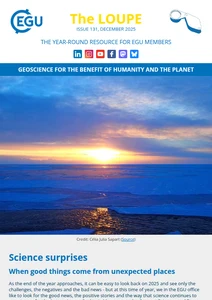
In our December Issue we we are focusing on positive stories of surprises in science. Asmae Ourkiya shared how a prize established in 1900 to reward anyone making contact with alien life (expect Martians) ended up funding more than a century of astronomy research and innovation. Guest blogger Fernanda Matos described the discovery her autism had been driving her interest in Oceanography for years, in her blog on how we can better support people with disability in geoscience. And we highlight some surprises to avoid in our blog on the Austrian visa and Schengen system ahead of EGU26. Also catch up on all the upcoming dates for webinars and funding, including €10,000 to host a Geoscience Day event in your European country, and share your opinions on where EGU should be focusing strategically in the next 5 years in the EGU Members' Survey.
All this and much more, in this month's Loupe!
Read more