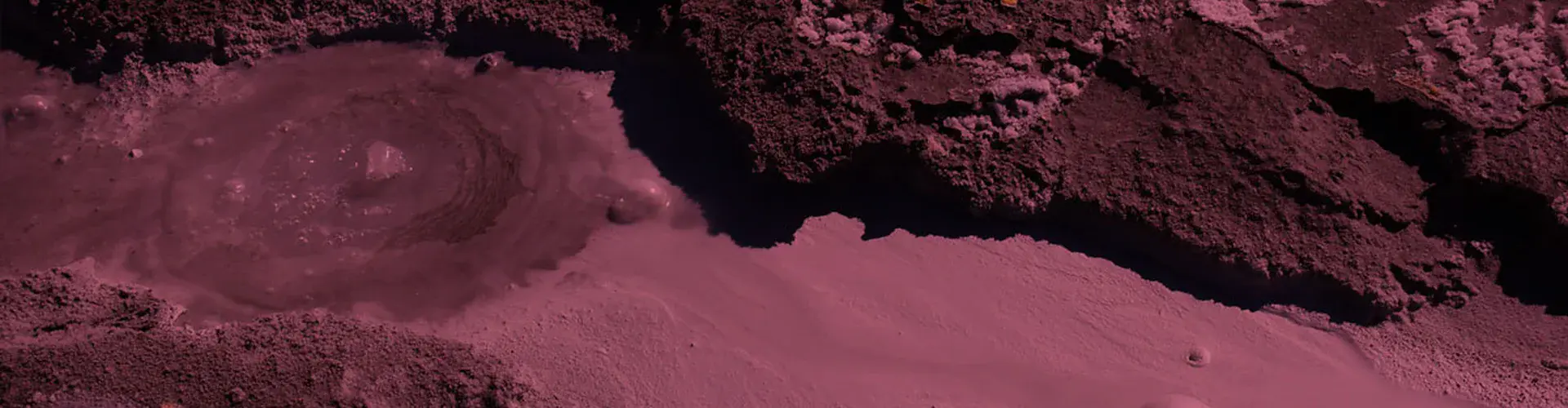
The disciplines Geochemistry, Mineralogy, Petrology, and Volcanology (GMPV) are the nexus of Earth processes. The GMPV Division addresses the chemical and physical properties of minerals that build our planet and their impacts on humanity and Earth’s habitability. The topics that fall under the GMPV purview include volcanic unrest and eruption; formation and evolution of continental crust; the role of atmospheric composition in habitability, via the geochemical record linked to mass extinctions; and the chemistry of the deep Earth, from mantle to core, including isotope geochemistry and radiometric dating. The science covered by GMPV also includes ocean chemistry and its control by ocean floor magmatism, weathering and erosion of continental crust, or cosmic input. The GMPV scope includes the traceability of fluid migration within the Earth through the study of ore deposits, geothermal systems as well as modifications of deep-seated rocks. In sum, the disciplines encompassed by the GMPV Division collectively describe the workings of complex and inter-connected systems in the Earth, providing the opportunity to speculate about other potentially habitable planets.
How do minerals shape the future of soils, and how do soils drive mineral transformations? This campfire highlights remediation strategies, contamination hazards, and mineral–soil interactions that control water quality, carbon storage, and ecosystem health. Join us on Wednesday, December 17th @ 11 am CET to explore how weathering, organo-mineral processes, and innovative approaches help tackle pollution, support climate resilience, and guide sustainable soil management. Our speakers for this joint edition are: Ewa Stępień (AGH University of Krakow), on “Fluid-mineral mediated …
The 2025 Robert Wilhelm Bunsen Medal is awarded to
Trevor Russell Ireland in recognition of his impact on understanding the history and processes of Earth and the Solar System through pioneering developments in spectroscopy instrumentation and his vision for applications.
The 2025 Division Outstanding Early Career Scientist Award is awarded to
Renée Jade Tamblyn for groundbreaking work in petrochronology of subduction processes, komatiite hydration and production of H2 as an energy source for early life, as well as her role in developing a new in-situ method for Lu-Hf geochronology.
Outstanding Student and PhD candidate Presentation (OSPP) Award
The 2025 Outstanding Student and PhD candidate Presentation (OSPP) Award is awarded to
Peter Lindquist The geologic record of hydration and dehydration in the subducting slab: Epidote minerals record alteration and metamorphism before and during subduction
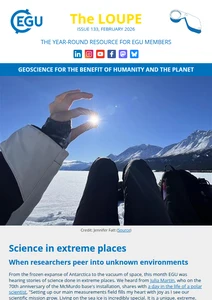
In our February issue, we are following pioneering scientists into extreme places in the name of discovery, from a day-in-the-life of an Antarctic researcher working on the sea ice to how the Viking spaceships took space plasma from theory to observation. Marie Cavitte shares her experience of the Blue Book traineeship in science for policy and Elsa Abs talks about their work with soil microbes. EGU's President thanks our 12,000 volunteers from 2025 and we share the 24 training schools and member-organised meetings we have funded in 2026. Deadlines approach for the EGU26 photo competition and Early-bird registration fees, and there is a job vacancy in the EGU Executive office in Munich, Germany!