President: Kerstin Treydte
(Emailcl@egu.eu)
Deputy President: Gabriele Messori
(Email)
ECS Representative: Shalenys Bedoya Valestt
(Emailecs-cl@egu.eu)
The Division on Climate: Past, Present & Future (CL) is one of the larger divisions of the European Geosciences Union. It pools from many disciplines and consequently has many co-organised sessions with other divisions at the EGU General Assembly. The division is very interdisciplinary and covers climate variations on all time scales. CL includes the study of any kind of climate archive from rocks to ocean cores, speleothems, ice cores, chronicles, to instrumental records to name a few. Besides observations, climate modelling on all time scales from the deep past to the future are areas covered by the division. Any aspect of the climate system falls into the realm of the division e.g. atmosphere, ocean, biosphere, cryosphere, and geology. Themes focus on the climate on Earth but may also expand other planets or the Sun.
Latest posts from the CL blog
What can Greenland ice cores tell us about winter extreme events over Europe?
Introduction Human-caused climate change is increasing the frequency of extreme weather events around the world, and Europe is no exception. These events typically last from a few days to several weeks or even months. Using climate models and reanalysis products, scientists are studying how extreme weather events will evolve and where they are likely to become more frequent and intense in a warming world, particularly in vulnerable regions. Paleoclimate research makes an important contribution to this effort. Changes in global …
Read more
Get ready for EGU26 with the Climate Division
Dear climate community, The EGU General Assembly 2026 (3–8 May) is almost here. With more than 21,000 presentations (orals, posters, and PICOs) on the schedule, it is time to plan your week. Before you travel, please keep these important updates and reminders in mind: Get the App: Download the EGU26 App (iOS or Android) to synchronize and manage your personal programme. Upload your files: Remember to upload your presentation and supplementary materials at least 24 hours before your session. Check …
Read more
Winds of change – How can we reconstruct the directions of winds in the past?
Invited guest from the EGU 2025 Outstanding Student and PhD candidate Presentation (OSPP) Award Wind is not easily visible. On historical time scales, its directions and velocities have been measured and recorded by instruments. To some degree, these parameters can also be simulated by climate models. But how about winds in the more distant past? And why would we want to know about them? In many places, wind has been a key agent in shaping the development of landscapes. This …
Read more
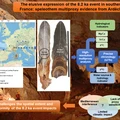
When a major climate event goes almost unnoticed: the elusive 8.2 ka signal in southern France stalagmites
Around 8,200 years ago, the climate of the Northern Hemisphere experienced an abrupt disturbance. In Greenland ice cores, the signal is unmistakable: a rapid drop in temperatures, followed by a gradual return to previous conditions. This episode, which lasted about 150 years, is known as the 8.2 ka event (“ka” meaning thousand years before 1950). It is often described as the most prominent climate perturbation of the Holocene (the last ~11,700 years). The widely accepted explanation involves a massive release …
Read more
Recent awardees

The 2026 Hans Oeschger Medal is awarded to
Friederike E.L. Otto for pioneering extreme event attribution and transforming climate communication through the World Weather Attribution initiative.
Read more

- 2026
- Division Outstanding Early Career Scientist Award
The 2026 Division Outstanding Early Career Scientist Award is awarded to
Marlow Julius Cramwinckel for innovative contributions to the combination of climate reconstructions and modelling to constrain climate, carbon cycle, and hydrological feedbacks in the past.
Read more

The 2025 Hans Oeschger Medal is awarded to
Heather Marie Stoll for pioneering contributions in both marine and terrestrial palaeoclimate research, which led to groundbreaking advancement in our understanding of rapid climate change, through forcings and feedbacks.
Read more

- 2025
- Milutin Milanković Medal
The 2025 Milutin Milanković Medal is awarded to
Zhengyu Liu for outstanding contributions to our understanding of global climate change by combining theoretical approaches, the development and use of a hierarchy of models, and model-data comparisons.
Read more

- 2025
- Division Outstanding Early Career Scientist Award
The 2025 Division Outstanding Early Career Scientist Award is awarded to
Kai Kornhuber for outstanding research on extreme weather and climate dynamics, including circumglobal patterns in the jet stream, their relation to heatwaves and food security, and representation in climate models.
Read more

- 2025
- Outstanding Student and PhD candidate Presentation (OSPP) Award
The 2025 Outstanding Student and PhD candidate Presentation (OSPP) Award is awarded to
Devika Moovidathu Vasudevan Upper Tropospheric Humidity and Cloud Radiative Forcing: A Tropical Perspective
Read more

- 2025
- Outstanding Student and PhD candidate Presentation (OSPP) Award
The 2025 Outstanding Student and PhD candidate Presentation (OSPP) Award is awarded to
Lison Soussaintjean Towards understanding the N2O production in dust-rich Antarctic ice
Read more
- 2025
- Outstanding Student and PhD candidate Presentation (OSPP) Award
The 2025 Outstanding Student and PhD candidate Presentation (OSPP) Award is awarded to
Ramona Schneider Magnetic fabric of Tajik loess-palaeosols as a palaeowind and process indicator
Read more

- 2025
- Outstanding Student and PhD candidate Presentation (OSPP) Award
The 2025 Outstanding Student and PhD candidate Presentation (OSPP) Award is awarded to
Tatiana Bebchuk Subfossil yew (Taxus baccata) wood from eastern England reveals mid-Holocene climate and environmental changes
Read more
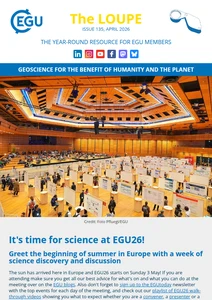
Current issue of the EGU newsletter
In our April issue, we are welcoming EGU26 with a range of tools and blog posts to help you get the most out of the meeting! Also meet the managing director or EGU's publications and conference partner company Copernicus, Martin Rasmussen, as he talks about how the General Assembly has changed in the last 20 years, the EGU awards and medals are now open for nominations, discover how footprints in muddy tidal flats are helping us learn about climate change and don't miss the 15 May deadline to apply for funding to support a training school or special conference!
All this and much more, in this month's Loupe!
Read more