President: Daniel Farinotti
(Emailcr@egu.eu)
Deputy President: Thomas Mölg
(Email)
ECS Representative: Aakriti Srivastava
(Emailecs-cr@egu.eu)
The cryosphere are those parts of the Earth and other planetary bodies that are subject to prolonged periods of temperatures below the freezing point of water. These include glaciers, frozen ground, sea ice, snow and ice. One of the main aims of the EGU Division on Cryospheric Sciences (CR) is to facilitate the exchange of information within the science community. It does so by organising series of sessions at the annual EGU General Assembly, and through the publishing of the open-access journal The Cryosphere. The division awards the Julia and Johannes Weertman medal for outstanding contributions to the science of the cryosphere.
Latest posts from the CR blog
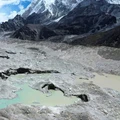
Chasing glacial lakes in the shadow of Everest
Turquoise lakes. Towering Himalayan peaks. A maze of rock, ice and meltwater. At first glance, this hardly looks like a glacier at all (Figure 1)… Yet as glaciers thin and retreat across the Himalayas, networks of meltwater ponds and glacial lakes are forming both on glacier surfaces and at their margins: one of the most visible signs of a changing high-mountain landscape. I spent four weeks in Nepal’s Sagarmāthā National Park in May and June 2025 as part of the …
Read more
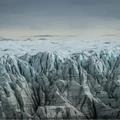
Using Generative Modelling to Downscale Climate Data for Ice Sheets
Greenland’s ice sheet holds enough water to raise global sea levels by over 7 meters, but predicting how much it will actually shrink remains challenging due to the massive computational cost of traditional models. Our latest research introduces machine learning-based downscaling that generates high-resolution climate fields orders of magnitude faster than conventional regional climate models. Inspired by AI image generators, our model takes coarse climate output, and learns to fill in realistic fine-scale details that capture local variability. This allows …
Read more
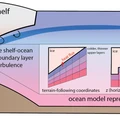
Melting ice shelves in ocean models: an idealised model intercomparison project
Antarctic ice shelves melt from beneath where they contact the ocean, but how well do ocean models simulate this process? Building on several decades of model development, a recent model intercomparison study compared ice shelf-ocean models from modelling groups around the world with the same, idealised benchmark configuration. From this effort, we can learn how current models perform, and how we can still improve them in the future. Why do we need ice shelf-ocean models? The Antarctic ice sheet is …
Read more
The Arctic’s Blind Spot: Why Satellites Struggle Where Ice Meets the Coast
The first time I stood on sea ice, I could not tell which direction the coast was. A community member named Bryan could. That gap in situational awareness, between what a trained remote sensing scientist could read from the landscape and what a local hunter understood instinctively, turned out to mirror almost exactly the gap in our satellite data: ICESat-2 produces reliable freeboard across the central Arctic but goes systematically blind within 25 km of every coastline. This post traces …
Read more
Recent awardees

- 2026
- Julia and Johannes Weertman Medal
The 2026 Julia and Johannes Weertman Medal is awarded to
Olaf Eisen for outstanding contributions to the application of geophysical methods to glaciers and ice sheets, and extensive professional service to the cryospheric community.
Read more

- 2026
- Arne Richter Award for Outstanding Early Career Scientists
The 2026 Arne Richter Award for Outstanding Early Career Scientists is awarded to
Kaitlin Naughten for pioneering modelling studies of Antarctic ice–ocean interactions and their implications for sea-level rise, as well as for outstanding leadership in polar climate science.
Read more

- 2025
- Julia and Johannes Weertman Medal
The 2025 Julia and Johannes Weertman Medal is awarded to
Shin Sugiyama for outstanding work in the field of glacier dynamics and ice-water interactions, including seminal contributions to our understanding of lake-calving glaciers and ice-dammed lake outbursts.
Read more

- 2025
- Outstanding Student and PhD candidate Presentation (OSPP) Award
The 2025 Outstanding Student and PhD candidate Presentation (OSPP) Award is awarded to
Antoine Savard A new parameterization of dilation using GODAR
Read more

- 2025
- Outstanding Student and PhD candidate Presentation (OSPP) Award
The 2025 Outstanding Student and PhD candidate Presentation (OSPP) Award is awarded to
Katie Lowery Drivers of Ice Shelf Basal Melt on Pine Island Glacier: Ocean vs Geometry?
Read more

- 2025
- Outstanding Student and PhD candidate Presentation (OSPP) Award
The 2025 Outstanding Student and PhD candidate Presentation (OSPP) Award is awarded to
Leah Sophie Muhle Towards a new method for estimating englacial attenuation
Read more

- 2025
- Arne Richter Award for Outstanding Early Career Scientists
The 2025 Arne Richter Award for Outstanding Early Career Scientists is awarded to
Brice Noël for outstanding research in the field of the surface mass budget of ice caps and ice sheets, based on regional climate modelling.
Read more
Current issue of the EGU newsletter
In our August issue, we reflect on the lessons learned from past disasters associated with natural hazards, and hear from the Early Career Scientist rep for the Natural Hazards Division Elisa Nobile. Don't miss your chance to register for one of our six autumn workshops and applications are open to volunteer with the Outreach Committee. The call for sessions for EGU27 is open and don't miss your chance to nominate someone to be the Union's next Early Career Scientist (ECS) Union-wide Representative or Treasurer!
All this and much more, in this month's Loupe!
Read more