
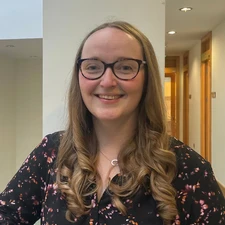
Claire Harnett
GMPV Geochemistry, Mineralogy, Petrology & Volcanology
The 2026 Arne Richter Award for Outstanding Early Career Scientists is awarded to Claire Harnett for exceptional field and experimental studies modelling the growth and collapse of volcanic structures, and geotechnical applications leading to improved assessments of volcanic instability and hazards.
In just a few years, Claire Harnett has established herself as an internationally known and respected researcher and teacher moving up the ladder with vigor and speed. Harnett demonstrated early talent for research in volcanology as recipient of the prize for best student talk at the 2018 meeting of the Volcanic and Magmatic Studies Group of the Geological Society of London. She subsequently followed a career trajectory that brought her from the University of Leeds in 2019, where she obtained her PhD degree, to Assistant (2019) and Associate (2024) Professor at University College Dublin (UCD). She holds a Professional Diploma in University Teaching and Learning, followed by being awarded an Excellence in Teaching and Learning Award in 2023, and a place on University College Dublin’s THRIVE Leadership in Research Program (currently open to only 14 faculty).
Harnett has a remarkable diversity of research strengths in volcanology, including the growth and demise of lava domes; rock mechanics; edifice stability; and discrete element modelling. Although her primary focus is volcanology, she brings engineering and mathematical proficiency to her work, along with a keen eye for description. Her standing in the volcanology field is demonstrated by an invitation to write a review paper on slope failure and a chapter on volcanic domes for the upcoming Encyclopedia of Volcanoes. At University College Dublin, she leads the Geohazards Research Group. In the six years since completing her PhD, she has brought in almost three million Euro in research funding, including an European Research Council Synergy Grant as one of four co-principal investigators (with only her share of the award counted in her total research funding). This European Research Council award has expanded her research team to include four new PhD students and two postdocs, markedly growing her research program in volcanology.
She has taken on essential responsibilities in professional service, including as Technical Editor for 'Volcanica', a leading open access journal in her field, and as a convenor of sessions at the EGU annual General Assembly every year since 2021. She led the effort to establish a global database for lava dome collapses, the instigating event for some of the most extreme volcanic hazards. She and her students have created scaled analog models of growing lava domes, identifying the underlying physical properties of both the magma and the dome (e.g., magma viscosity, plug cohesion, plug aspect ratio) that control dome evolution over time. These properties are essential for predicting the growth of a dome and the associated potential hazards related to future eruptions and/or dome collapse. Teaching is clearly a responsibility Claire takes seriously. At University College Dublin, she has designed and led a module for an MSc course in Rock Engineering, and taught BSc courses in Natural Hazards, Geology for Civil Engineers, Volcanic Environments, Field Geology, and Principles of Scientific Inquiry. This diversity in teaching speaks to her broad interdisciplinary expertise, spanning geology and engineering.