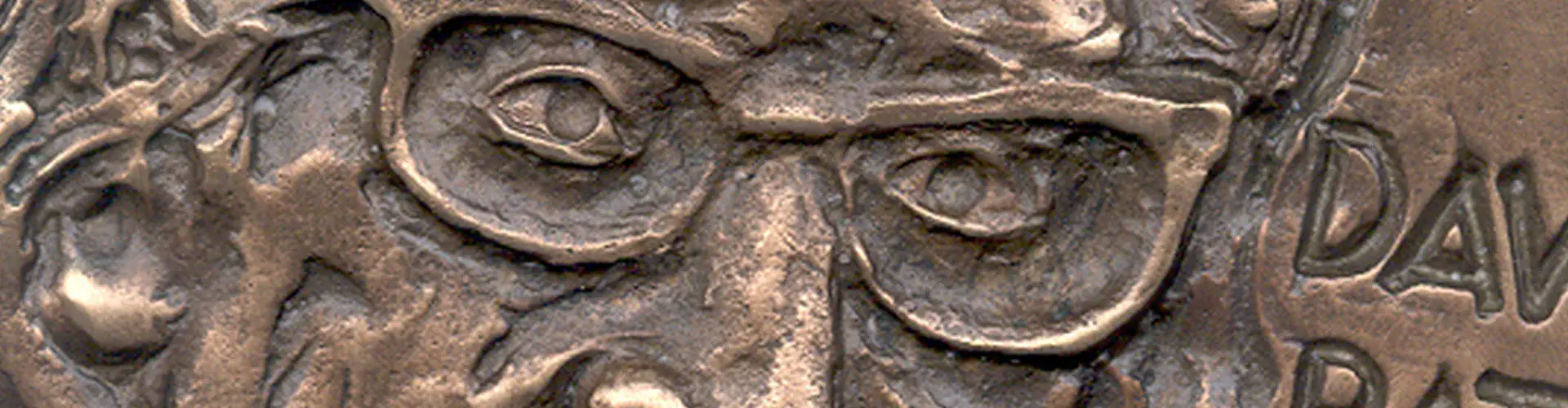

Patrick Irwin

The 2026 David Bates Medal is awarded to Patrick Irwin for outstanding contributions to the study of giant planet atmospheres, together with exemplary commitment to mentoring, community building, and open science.
Patrick G. J. Irwin, Professor of Planetary Physics and Fellow of St. Anne’s College at Oxford University, has made fundamental contributions to our understanding of the atmospheres of the giant planets, including transiting exoplanets. Irwin has played, and continues to play, a pivotal role in advancing the interpretation of planetary spectra, offering groundbreaking contributions to planetary atmospheric science. Over the course of his career, Irwin has combined modelling and radiative transfer analyses of all major solar system atmospheres with observations from multiple space missions and ground-based telescopes to characterise their dynamics, composition, and cloud structures. Some of his recent notable achievements include the discovery of hydrogen sulfide on Uranus and Neptune, with fundamental consequences for their formation, and the characterisation of their vertical cloud structure and subtle color variations.
One of his main achievements in planetary sciences is the development of the radiative transfer and retrieval code NEMESIS (Non-linear Optimal Estimator for Multivariate Spectral Analysis), a modelling tool that began as an analysis tool for a single instrument that he expanded into a versatile suite of methods capable of addressing radiative transfer analyses across a wide variety of atmospheres and spectral ranges. His commitment towards making NEMESIS an openly available code, along with his leadership and mentorship around NEMESIS, has fostered a global community of students, postdocs, and academics who continue to expand the code’s applications, enabling groundbreaking science such as the detailed spectroscopic analysis of revolutionary data from the James Webb Space Telescope.
Besides his modleling work, Irwin has been deeply involved in instrumentation for space missions. His contribution to the development and scientific exploitation of Cassini’s Composite Infrared Spectrometer (CIRS) has yielded fundamental discoveries about Saturn and Titan’s atmospheric structure, composition, and seasonal variations. Beyond the Solar System, his early studies on transit spectroscopy on Earth- and Jupiter-like exoplanets and his continuous support of NEMESIS applications in exoplanetary science have been at the forefront of exoplanet atmospheric characterization. Irwin has mentored an extensive number of Ph.D. candidates, and his textbook on 'Giant Planets of our Solar System' stands as a fundamental reference for understanding the structure, physical processes, and sources of information to understand Giant planets.
In conclusion, Patrick Irwin’s groundbreaking contributions to the study of giant planet atmospheres, his pioneering role in exoplanet atmospheric science, his instrumental leadership in missions like Cassini/CIRS, and his community service through the development of highly used open-source codes exemplify the best of planetary sciences. His work has profoundly shaped our understanding of planetary atmospheres, both within the Solar System and beyond, and his leadership and legacy make him a highly deserving recipient of the EGU 2026 David Bates Medal.