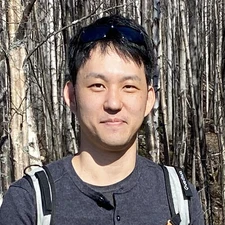
Kurama Okubo
SM Seismology
The 2026 Division Outstanding Early Career Scientist Award is awarded to Kurama Okubo for outstanding contributions to earthquake physics that integrate numerical modelling, observational seismology, and laboratory experiments, to illuminate complex rupture dynamics and fault mechanics.
Kurama Okubo is recognised for his exceptionally multidisciplinary research redefining the boundaries of traditional seismology and synthesizing theory, observation, and experiments to advance our understanding of how earthquakes rupture. Okubo's research helps to bridge the gap between theoretical predictions and physical observations, offering new insights into complex earthquake mechanics. In numerical studies that represent both the continuous deformation of rock and off-fault fractures, Okubo has demonstrated how damage that forms around a moving fault influences how much energy an earthquake converts into seismic waves versus how much is spent breaking host rock. This work provides a clearer physical basis for how the resulting damage patterns may preserve clues about rupture dynamics. He extracted faint, gradual changes from continuous seismic data at the well-instrumented Parkfield section of the San Andreas Fault in California. By analysing two decades of records, Okubo connected small variations in wave speed to evolving properties of the fault region, offering a direct view of how a fault changes between large events. He also contributed to the characterisation of slow slip events in southwest Japan along the Nankai Trough, to better understand how deformation is partitioned between rapid earthquakes and transient fault motion, with implications for assessing hazards in subduction zones. His recent laboratory work includes creating controlled roughness patches on simulated faults and directly observing how ruptures interact with these obstacles.
Across these lines of research, Kurama Okubo combines new methods with a collaborative approach that bridges communities in Europe, North America, and Japan. His contributions, spanning simulation, observation, and experiment, have already made earthquake physics research more connected across scales.