How social media data and analytics are informing disaster management research
28 January 2026
Munich - January 28, 2026: Social media data are increasingly being analysed to support disaster preparedness, response, and recovery. A new comprehensive NHESS review examines how such data are being used in disaster management research.
Far from simply a source of unstructured online content, disaster management in the digital age can be supported by careful analysis of online social-media data, suggests a new paper published today by the EGU journal Natural Hazards and Earth System Sciences (NHESS) titled “Social Media for Managing Disasters Triggered by Natural Hazards: A Critical Review of Data Collection Strategies and Actionable Insights.”
This systematic review, authored by Lakshmi S. Gopal, Rekha Prabha, Hemalatha Thirugnanam, and Maneesha Vinodini Ramesh from the Center for Wireless Networks & Applications (WNA), Amrita Vishwa Vidyapeetham, Amritapuri, India, and Bruce D. Malamud, Director of the Institute of Hazard, Risk and Resilience (IHRR), Durham University, UK, examines how social media users have been conceptualised in the scientific literature as a potential “human sensor network”, while assessing the limitations, biases, and reliability challenges associated with such data.
After cataloguing over a decade of disasters triggered by natural hazards, from floods and hurricanes to earthquakes, the researchers critically review 250 peer-reviewed articles, conference proceedings, reports and book chapters published between 2010 and 2023. The review shows that, when refined using natural language processing and machine learning techniques and combined with appropriate relevance filtering, social media data can contribute strongly to situational awareness, community engagement, and the identification of needs during disasters.
“Social media is no longer just a communication tool during disasters; it is part of the response infrastructure itself. When used carefully, it can help responders identify urgent needs, allocate resources faster, and strengthen community resilience,” said Lakshmi S. Gopal.
Methodologically, the study establishes the open access Social Media Literature Database (SMLD), an expansive framework that classifies 250 studies of social media and disasters, published between 2010 and 2023. The authors categorised this vast body of research into seven main categories and 27 subcategories, covering case study regions, specific disaster types including floods, hurricanes, earthquakes, storms, wildfires, landslides, and volcanic eruptions, and the nuanced characteristics of data across platforms like X (formerly called Twitter), Facebook, and Reddit. This taxonomy provides structured insight into the field’s technological evolution, highlighting how different analytical approaches have been used to identify needs such as resource shortages, infrastructure impacts, and community responses.
The review documents a gradual increase in the application of natural language processing and machine learning techniques within massive, unstructured social media datasets, particularly for relevance filtering, event detection and sentiment analysis. However, the authors note that more advanced neural network approaches remain comparatively under-represented, and that many studies rely on keyword-based data collection methods.
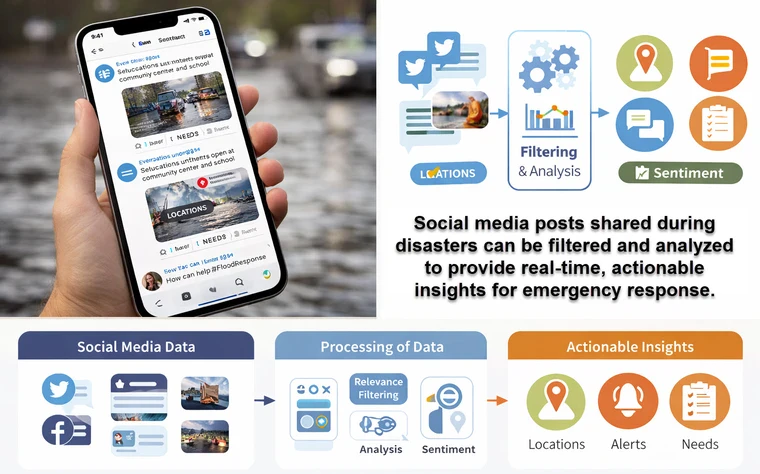
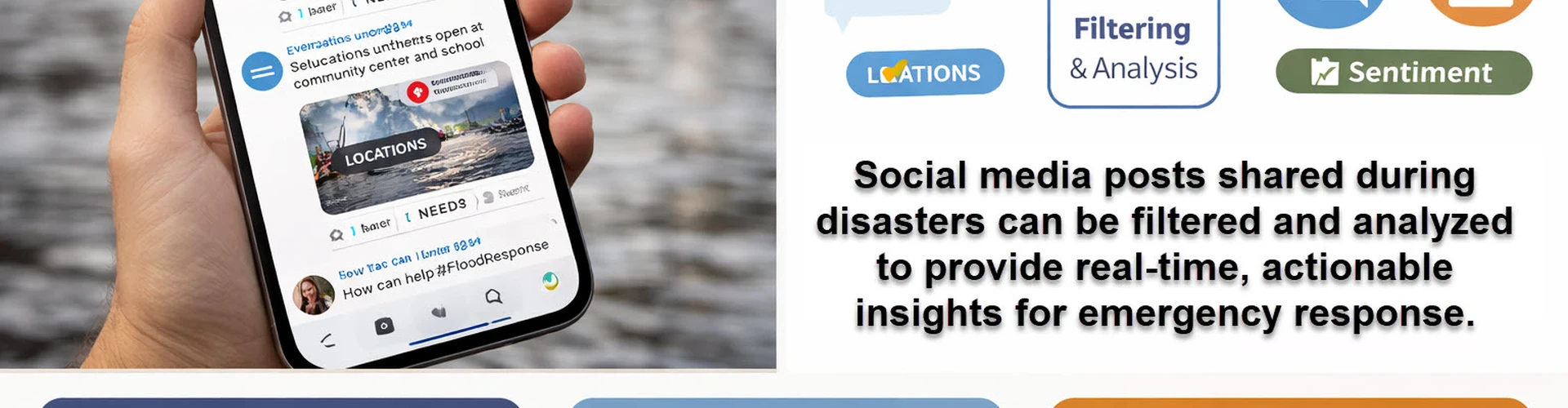
Social media posts shared during a flood event show how user-generated information can be filtered and analysed to provide actionable insights for disaster management. Illustrative image generated using AI.
By integrating temporal and spatial metadata, elements that are usually overlooked in traditional emergency protocols, the research identifies how to transform user-generated content into what the authors call “actionable information”. Such information can support situational awareness, identify affected locations, analyse public sentiment, and highlight potential resource needs, rather than predicting disasters themselves.
“What this review shows is that social media data can support disaster management, but only when its limitations are clearly recognised,” said Bruce D. Malamud. “Social media does not replace official data or professional judgement. Its value lies in complementing existing information sources, particularly by highlighting local impacts, needs, and perspectives that may otherwise be missed.”
This study guides researchers and practitioners on best practices and persistent gaps in the use of social media data for disaster management. It argues that social media analytics should be carefully integrated into existing official disaster risk management frameworks to reduce the risk of misinformation and missed vulnerabilities. By identifying both strengths and limitations in current practice, the review highlights where future research and operational development are most needed.
More information
Addendum: Please be advised that due to a technical error, this paper was published on Monday, January 26. The official publication and embargo date remains Friday, January 30, at 09:00 CET. We apologize for any confusion.
About the EGU
The European Geosciences Union (EGU) is the leading organisation for Earth, planetary and space science research in Europe. With our partner organisations worldwide, we foster fundamental geoscience research, alongside applied research that addresses key societal and environmental challenges. Our vision is to realise a sustainable and just future for humanity and for the planet. The annual EGU General Assembly is the largest and most prominent European geosciences event, attracting over 20,000 scientists from all over the world. The meeting’s sessions cover a wide range of topics, including volcanology, planetary exploration, the Earth’s internal structure and atmosphere, climate, as well as energy and resources. For
Contact
Media and Engagement Manager Asmae Ourkiya
European Geosciences Union
Emailmedia@egu.eu