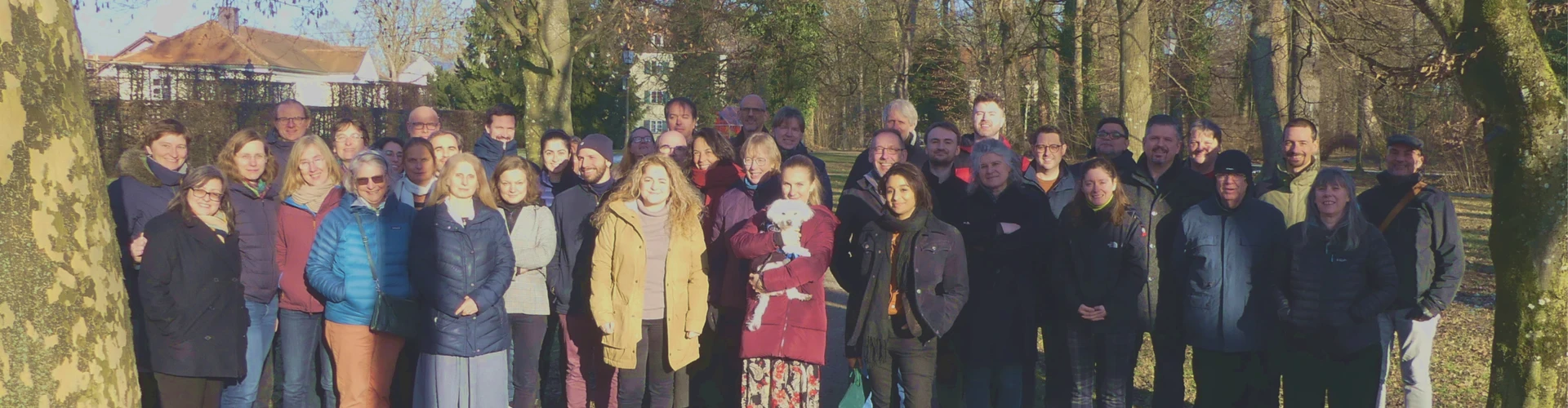

Thank you to all EGU volunteers who gave their time in 2025!
27 February 2026
In 2025 the European Geosciences Union continued to deepen our role within our community, with 3961 scientific articles published in our 19 public peer-reviewed and open access journals, and an incredible 20,984 people discovering new exciting science from the 18,934 presentations in the Earth, planetary and space sciences delivered during EGU25, both onsite in Vienna and online around the world! These things were only possible because of the innovation, dedication and enthusiasm of the over 12,000 volunteers who donated their time last year, to whom EGU wants to say a resounding ‘Thank you’!
EGU’s volunteers are active in many areas of the Union, from the approximately 9,500 people who generously participate in our open access publications process, either as editors, reviewers or moderators of EGU’s preprint repository EGUsphere.
Many of you will have interactions with one of the 3,957 volunteers who help organise the annual General Assembly, either as conveners or co-conveners of sessions, as members of the Programme Groups who co-ordinate the scientific content of the meeting, or in a range of other roles.
Apart from this, our volunteers choose the focus and direction of the Union, often as one of the 221 people who work tirelessly with one or more of our ten Committees and Working Groups overseeing everything from the Union’s efforts to improve Equality, Diversity and Inclusion, our Finance and Executive strategies, to the Education and Outreach support we provide to science communicators and teachers.
Underpinning all the work that we do at EGU is a strong commitment to supporting both fundamental and applied geoscience research, that addresses key societal and environmental challenges. This commitment is structured by the activities of our 22 scientific Divisions, formed of 514 volunteers at every career stage, from the Early Career Representatives to the Division Presidents and members of Council.
EGU’s President Peter van der Beek shared his thanks on behalf of the Union, “2025 was a very good year for EGU, thanks to the tireless and creative work of our thousands of volunteers. Despite the current uncertainty and instability, and the challenges faced by many people around the world, EGU members continued to demonstrate what an open, community-minded, and welcoming scientific organisation can be. We achieved several important milestones in 2025, such as the inauguration of our Ethics Committee, and the development of the Emergency Support policy, all while continuing to champion cutting-edge, open science. With the introduction of our more transparent, inclusive and equitable article-processing charges for our journals and the launch of the new interactive open-access journal “Earth Observation”, EGU publications remain robust, and the quality of research published improves every year. The General Assembly attracted more participants than ever, as we continue to develop our new hybrid model of the meeting. In fact, all the EGU Committees remained dedicated to supporting EGU members, providing a wide range of training and funding opportunities. Despite the trying times of the last few years, I am excited to see what 2026 will hold for EGU and our members, and I cannot express how grateful I am to be a part of this dedicated and curious community. Thank you all!”
Thank you so much, to all the volunteers from 2025!
More information
The European Geosciences Union (EGU) is Europe’s premier geosciences union, dedicated to the pursuit of excellence in the Earth, planetary, and space sciences for the benefit of humanity, worldwide. It is a non-profit interdisciplinary learned association of scientists founded in 2002 with headquarters in Munich, Germany. The EGU publishes a number of diverse scientific journals that use an innovative open access format and organises topical meetings plus education and outreach activities. Its annual General Assembly is the largest and most prominent European geosciences event, attracting more than 20,000 scientists from all over the world. The meeting’s sessions cover a wide range of topics, including volcanology, planetary exploration, the Earth’s internal structure and atmosphere, climate, energy, and resources.