
Vijay Prasad Dimri
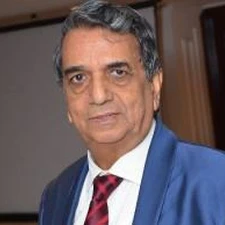
The 2026 Christiaan Huygens Medal is awarded to Vijay Prasad Dimri for outstanding contributions to the study of potential fields in exploration geophysics, by establishing their scaling properties due to scaling sources.
Vijay Prasad Dimri is a pioneer in the use of scaling models of rock density and magnetization combined with geopotential theory. He systematically studied Earth's magnetic and gravity field with fractal and spectral analysis and formulated an important relationship establishing the scaling properties of potential fields due to scaling sources. He applied these methods to a wide range of topics, including exploration geophysics, CO₂ sequestration for enhanced oil recovery, global warming, and many other challenging issues.
His pioneering work in signal processing and fractals in geosciences has paved the way for new methods of acquiring geopotential field data, enabling more accurate detection of geophysical anomalies. He has proposed innovative data processing techniques to improve the delineation of the geophysical anomalies, which are summarised in his numerous books, such as 'Deconvolution and Inverse Theory'. Furthermore, Dimri developed also a new technique to estimate the 'Depth to the Bottom of Magnetic Sources' and contributed to the modelling of complex geo-spaces using the Voronoi tessellation with fractal concepts and their potential field responses (US patent 2007).
Dimri is an internationally known, distinguished scientist; he was the Oxford Award Lecturer for the AOGS (2010) and World Academy of Sciences fellow (FTWAS). He was also the Lorenz Awardee of AGU for Nonlinear Process (2007). He is intensely active in the organization of workshops, conferences, and delivering invited talks.
Dimri was director of leading geoscience institutions in India, such as the National Geophysical Research Institute (NGRI) from 2001 to 2010, demonstrating exceptional leadership skills and a remarkable ability to foster collaboration among multidisciplinary teams. He adopted an inclusive approach, promoting international scientific cooperation and embracing diverse perspectives. His ability to communicate complex scientific concepts to a wide range of audiences is exemplary, as evidenced by his numerous invited talks at national and international conferences.
Finally, Dimri has demonstrated a strong commitment to mentorship, actively supporting the professional development of junior researchers. His passion for sharing knowledge and nurturing the next generation of scientists is admirable. He is one of the 'Top 100 Great IITians' (an initiative of the Indian Institute of Technology), a group of influential and successful Indians dedicated to serving their nation.