
New research proposes Dante’s Inferno modelled a planetary impact 500 years before modern science!
1 May 2026
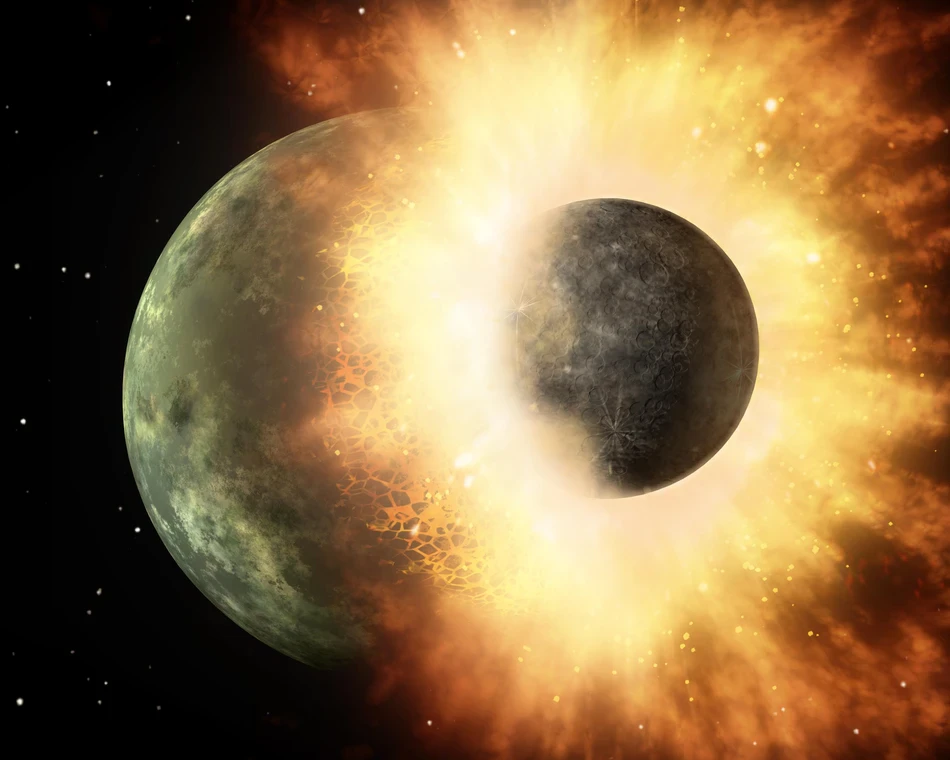
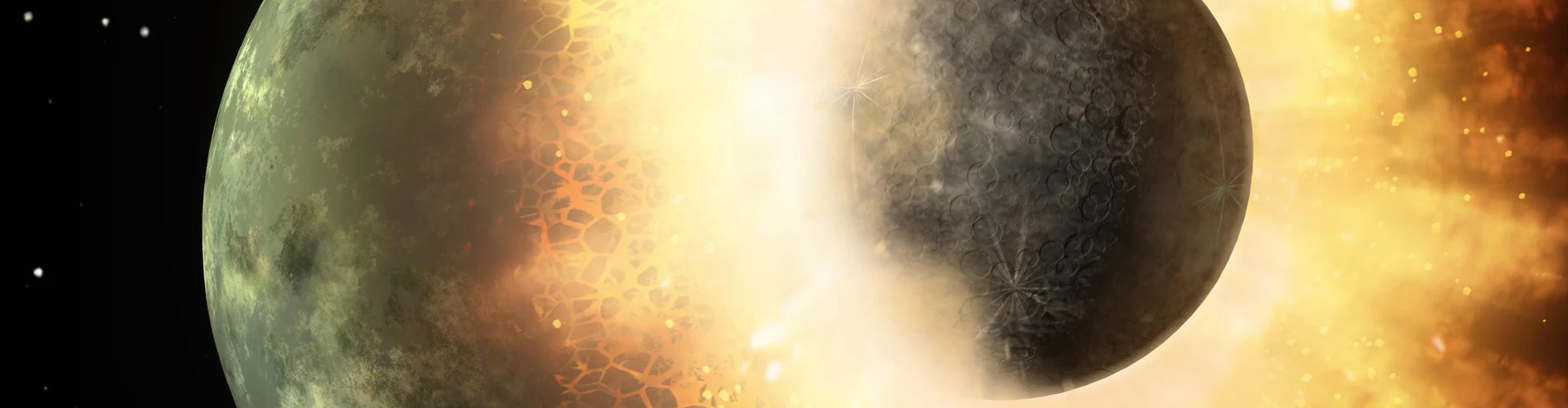
Artist's depiction of a collision between two planetary bodies, similar to the hypothesized collision between Theia and the proto-Earth. Source: https://en.wikipedia.org/wiki/Theia_(hypothetical_planet)#
Vienna, Austria - New research reveals that Dante Alighieri’s Inferno wasn’t just a masterpiece of literature: it was a gedankenexperiment in impact physics. From multi-ring craters to shockwaves that reshaped the globe, discover how a 14th-century poet modelled a planetary impact 500 years before the birth of modern meteoritics.
For seven centuries, the descent of Dante Alighieri’s Satan has been read as a spiritual tragedy: a silent, heavy fall from grace. However, groundbreaking new research from Timothy Burbery of Marshall University suggests that the Divine Comedy contains a far more explosive secret. By reappraising the 14th-century masterpiece through the lens of modern meteoritics, Burbery proposes that Dante envisioned Satan as a high-velocity impactor hitting the Southern Hemisphere and tunnelling to the Earth’s centre. This impact forces the Northern Hemisphere to retreat, which, consequently, forms the core of Hell as a bottom-up crater, while the earth displaced behind Satan creates the mountain of Purgatory as a central peak.
The scale of this event parallels the Chicxulub (K-Pg) impact that ended the reign of the dinosaurs. Burbery suggests treating the Prince of Darkness as an oblong, asteroid-sized body, reminiscent of the interstellar object Oumuamua, whose arrival followed the harrowing logic of a global extinction event. Much like the K-Pg asteroid, this collision triggered a planetary chain reaction: it tunnelled to the core and generated the central peak of Mount Purgatory. Like the Hoba meteorite, which remains a 60-ton intact mass, Dante’s Satan is modelled as a physical, un-vaporized impactor that permanently restructured the Earth’s architecture.
In this light, the nine circles of Hell are no longer merely symbolic tiers of sin, but rather a remarkably accurate description of the concentric, terraced morphology found in multi-ring impact basins across the solar system, from the Moon to Venus. Anticipating the non-Euclidean geometry later found in the Paradiso, Dante intuitively mapped the physics of terminal velocity and crustal breach required for a massive object to reach maximum compression at the Earth’s core.
This research offers a significant tool for planetary defence, as it demonstrates how literary geomythology can raise awareness of physical threats long before their scientific formalization. Burbery argues that Dante effectively discovered the geological reality of meteors, and this challenges the Aristotelian dogmas that viewed the heavens as perfect and unchanging.
When depicting Satan’s fall as a tangible, high-velocity impact with devastating physical effects rather than a mere optical illusion or spiritual allegory, Dante helped shift the Western paradigm toward recognising celestial bodies as physical agents of change. This interdisciplinary bridge fosters a sense of Kuhnian humility and reminds us that ancient narratives may encode planetary truths that modern science is only beginning to model.
The Divine Comedy is a fascinating literary, and now, a geophysical gedankenexperiment, one that deepens our own understanding of meteoritics, both in terms of its anticipations of the modern science, and in terms of how it diverges from it.
More information
When reporting on this story, please mention the EGU General Assembly 2026, which is taking place from 03– 08 May 2026. This paper will be presented in Session ITS3.4/GM3 at EGU26 on Friday, 08 May, 14:00–15:45 (CEST), Display time Friday, 08 May, 14:00–18:00 Hall X2, X2.13
If reporting online, please include a link to the abstract: https://meetingorganizer.copernicus.org/EGU26/EGU26-14300.html