Congratulations to EGU’s 2026 Science Journalism Fellows!
15 September 2026
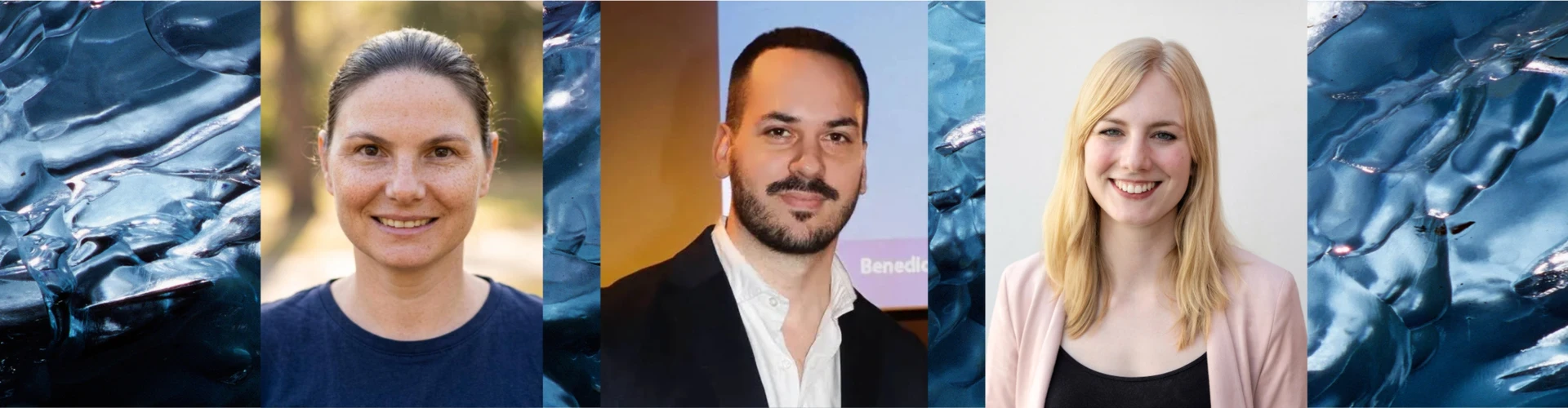
The European Geosciences Union (EGU) is excited to announce this year’s Science Journalism Fellowship awardees: Sophie Fessl, Rebecca Wolfer, and Antonio Alonso Rodríguez. This year's projects range from sustainable wet farming and AI-driven critical mineral extraction to long-term volcanic hazard monitoring.
Germany’s Wet Farming Experiment: Can Paludiculture Save Peatlands and Pay for Itself?
Awarded 2,250 EUR, this project by Sophie Fessl investigates the emerging German market for paludiculture: the practice of farming on rewetted peatlands. Peatlands cover only 3% of the Earth's land surface yet represent its largest terrestrial carbon store. However, conventional drainage for agriculture causes peat to decompose, releasing greenhouse gases. With Germany launching its "Palu" funding programme in 2026, aiming to rewet 90,000 hectares backed by 1.75 billion EUR in federal funding, this project asks whether paludiculture can simultaneously protect peat ecosystems and produce viable commercial products like insulation or anti-erosion mats.
“Paludiculture may be a key component for mitigating the climate crisis, but peatlands' importance for our atmosphere remains underappreciated and paludiculture needs to still prove itself,” Fessl explains.
The reporting will span three stages: inspecting peat formation research with Prof. Jürgen Kreyling at the University of Greifswald, examining wet agricultural operations at the Klimafarm pilot site in Schleswig-Holstein, and tracking the market viability of harvested biomass. Sophie Fessl is an Austrian science journalist. She writes about basic research, its intersections with society and how scientific discoveries shape everyday life. Her work has appeared in publications including New Scientist, GEO, Spektrum der Wissenschaft and Austrian daily newspapers.
The Volcano That Didn't Stop
Awarded 2,300 EUR, this project by Antonio Alonso Rodríguez is a character-driven, 22 to 25 minute documentary short film exploring the ongoing, post-eruption scientific and social realities of the Cumbre Vieja volcano on La Palma. Five years after its 85-day eruption in 2021, news coverage has vanished, yet high CO2 emissions, diffuse soil venting, and micro-earthquakes continue to impact local communities.
“This kind of long-term hazard monitoring is precisely the geoscience that struggles to get a camera pointed at it: it is continuous, repetitive, and largely inconclusive in the short term, which makes it the opposite of a news story,” Rodríguez emphasizes.
The film centers on a Greek volcanologist working with Spain's National Geographic Institute who bridges the gap between high-level monitoring networks and the daily lives of residents living near hazardous lava fields. The documentary will highlight low-cost sensor networks and long-term hazard monitoring, science that is vital across Europe yet often invisible to the public. The finished documentary aims for placement in major international film festivals (such as IDFA, CPH:DOX, and Hot Docs) and broadcast channels like ARTE and Euronews, alongside short-form content for social media and scientific outlets. Antonio Alonso is a film director, university professor and researcher based in Madrid. A full-time professor at Universidad Europea de Madrid, he teaches screenwriting and film directing while completing a PhD in audiovisual narrative. His award-winning documentaries and short films — including Tres mujeres, un caminoand El Abogado, with awards in Italy, Canada and Spain — bridge cinematic storytelling and academic research. He has also contributed to productions for Netflix, Paramount and Viacom International Studios.
Mining the Future: How Artificial Intelligence and European-Chilean Research Could Transform the Recovery of Critical Raw Materials
Awarded 1,890 EUR, this project by Rebecca Wolfer addresses the environmental and social challenges of extracting critical minerals, such as copper, lithium, and cobalt, essential for the global energy transition. Reporting directly from Germany and Chile's Petorca region, the project examines the EU-funded "OPTIMINER" initiative. OPTIMINER brings together 20 European and Chilean partners to test how digital tools (including machine learning, intelligent ore sorting, digital twins, and bioleaching) can sustainably extract minerals from low-grade ores and mining waste.
“Europe's efforts to decarbonize its economy have drastically increased demand for these minerals, yet mining often comes with high environmental and social costs,” Wolfer notes.
Wolfer will evaluate how AI-driven optimisation can reduce water and energy footprints in mining while exploring the broader geopolitics of Europe's mineral demand. Rebecca Wolfer studied journalism, religion and political science in Dortmund, Germany. As a freelance journalist, she has written for publications such as Frankfurter Rundschau, WELT, NOZ and Good News Magazin, and has reported from countries including South Korea, Mauritius and Namibia.
More information
The EGU Science Journalism Fellowship is an annual competition open to professional journalists wishing to report on ongoing research in the Earth, planetary and space sciences. The winning proposals receive up to €10,000 to cover expenses related to their projects and travel to the General Assembly. This support is intended to allow the fellows to follow geoscientists on location and to develop an in-depth understanding of their questions, approaches, findings and motivation.
The European Geosciences Union (EGU) is Europe’s premier geosciences union, dedicated to the pursuit of excellence in the Earth, planetary, and space sciences for the benefit of humanity, worldwide. It is a non-profit interdisciplinary learned association of scientists founded in 2002 with headquarters in Munich, Germany. The EGU publishes a number of diverse scientific journals that use an innovative open access format and organises topical meetings plus education and outreach activities. Its annual General Assembly is the largest and most prominent European geosciences event, attracting more than 20,000 scientists from all over the world. The meeting’s sessions cover a wide range of topics, including volcanology, planetary exploration, the Earth’s internal structure and atmosphere, climate, energy, and resources. For more information, follow the EGU on our social media.
Contact
Solmaz Mohadjer
EGU Outreach Committee Chair
Emailoutreach@egu.eu
Asmae Ourkiya
Media and Engagement Manager
European Geosciences Union
Munich, Germany
Emailmedia@egu.eu