
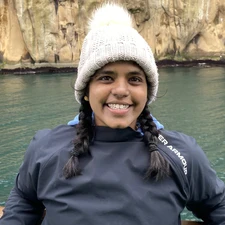
Oviga Yasokaran
NH Natural Hazards
The 2026 Outstanding Student and PhD candidate Presentation (OSPP) Award is awarded to Oviga Yasokaran for the poster/PICO entitled:
Determining the spatio-temporal patterns of intraplate earthquakes in the Western Quebec Seismic Zone using clustering analysis (Yasokaran, O.; Heron, P. J.)
Click here to download the poster/PICO file.
Oviga Yasokaran is a Master of Science (MSc) student with the Department of Physical & Environmental Sciences (DPES) at the University of Toronto, supervised by Prof. Philip Heron. Her thesis focused on applying clustering analysis to determine the spatial and temporal patterns of intraplate seismicity. Specifically, her research investigated the Western Quebec Seismic Zone (WQSZ), an active intraplate seismic region in eastern Canada.
In her work presented at EGU26, Oviga applied the Density-Based Spatial Clustering of Applications with Noise (DBSCAN) clustering algorithm to approximately four decades of earthquake records from the region. Moving beyond the limited range of parameter combinations commonly explored in DBSCAN applications, she systematically evaluated more than 70 clustering scenarios generated from different combinations of DBSCAN input variables. The results demonstrated that different parameter choices can produce substantially different spatial patterns, and consequently, different geological interpretations. Her findings highlight an important limitation in the application of clustering analysis to geoscientific datasets: a clustering algorithm alone may be insufficient to identify the most geologically representative patterns.
By integrating the clustering results with temporal analyses and available geological information, Oviga identified spatial patterns consistent with the reactivation of ancient crustal structures inherited from past tectonic events. These findings suggest that these ancient structures may contribute to present-day seismicity in the region. Her research demonstrates the importance of evaluating a broad range of clustering parameters when interpreting large geoscientific datasets and provides a framework for using clustering analysis across geoscience disciplines.