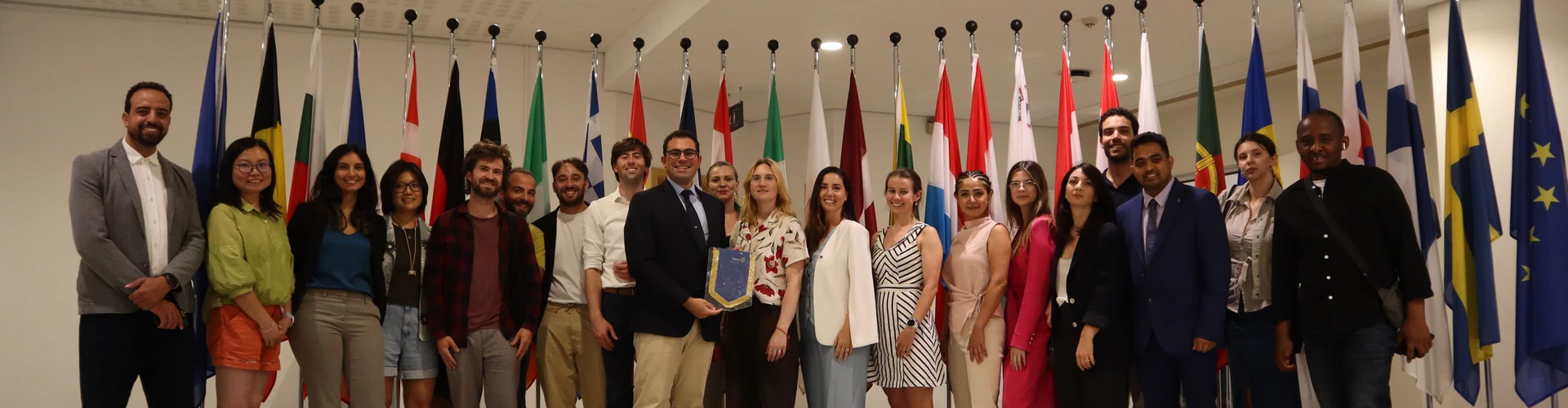
Early Career Scientists step into the role of European policymakers at the first MEP4ECS event
21 September 2026
From 14-16 July 2026, Early Career Scientists (ECS) from across Europe gathered in Brussels for the first Model European Parliament for Early Career Scientists (MEP4ECS), an initiative funded by the European Geosciences Union’s (EGU) Special Activity Fund. Through training, institutional exchanges and a parliamentary simulation, participants practical insight into the European Union’s policymaking processes while strengthening the skills needed to engage effectively at the science-policy interface. Organised by Fondazione ISSNOVA, with the collaboration of Rotary Club Global ROOTS, MEP4ECS brought together 20 researchers representing a wide range of countries, disciplines and professional backgrounds.
The three day programme focused on one of Europe’s most urgent challenges: adapting societies and territories to the growing impacts of climate change. Participants were introduced to the institutional framework of the European Union, the role of the European Parliament and the procedures used within parliamentary committees and plenary sessions. They then took on the role of parliamentary delegates, examining scientific evidence, negotiating priorities and developing shared policy proposals on climate change adaptation. Rather than simply presenting their own research, participants were challenged to consider different territorial needs, political perspectives and practical constraints. They had to identify common ground, respond to amendments and transform complex scientific knowledge into language that could support political decisions.
Participating in the Model European Parliament for Early Career Scientists (MEP4ECS) was a truly enriching experience that strengthened my understanding of how scientific evidence can be effectively translated into policy through collaboration, negotiation, and dialogue to address climate adaptation challenges. Dr Nazimul Islam
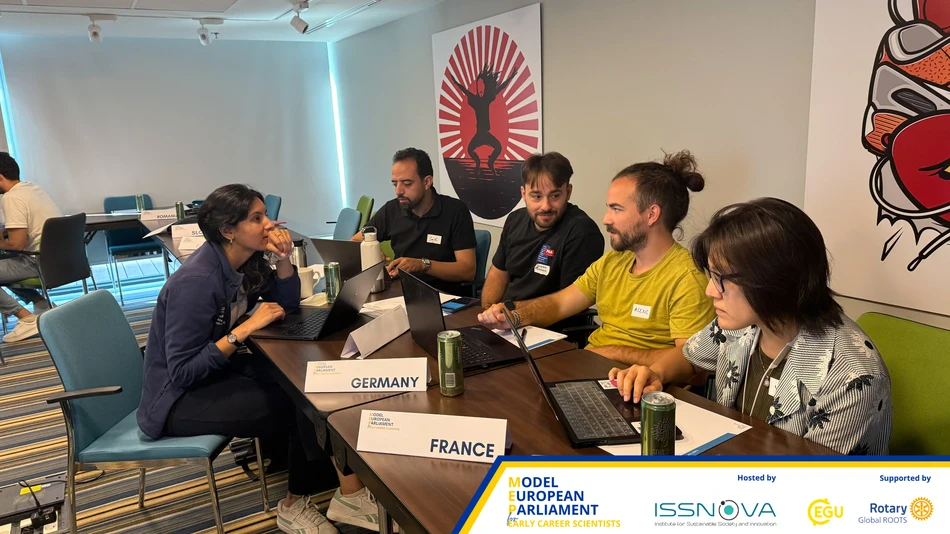
The Early Career Scientists gathered in groups to role-play as their respective countries. Photo credit: Maria Vittoria Gargiulo, Marcello Andria and Nazimul Islam
From scientific evidence to political decision-making
Alongside the simulation, participants met representatives working within European institutions and discussed how scientific expertise contributes to European policymaking. A session with Estelle Paulus from the European Commission’s Directorate-General for Climate Action explored European climate adaptation policies, implementation challenges and the importance of connecting scientific research with governance and resilience strategies. Participants also met Gregor Erbach from the European Parliamentary Research Service, who provided insight into how scientific evidence is assessed, communicated and used to support the work of Members of the European Parliament.
It has been a true pleasure to exchange views on the use of scientific evidence in policy-making with this group of smart and motivated early-career scientists, and to explain the role of the European Parliament Research Service in evidence-based policy-making. MEP4ECS is an important new initiative, in light of geoscientists’ key role in generating policy-relevant evidence and communicating it effectively to decision-makers. I was impressed by the depth of the discussions, the energy of the participants, and the quality of the draft outcome document. Gregor Erbach
Fostering the connection between science and policy making is very important, particularly for climate change adaptation and resilience. We hence welcome initiatives enabling early career scientists to better understand the needs and works of policy making and providing them with hands-on experience to strengthen the policy readiness of their research and communication in the future. Estelle Paulus
Creating mock legislation recommendations
The main outcome of the Model European Parliament was the Coherent Climate Adaptation Program, a piece of mock legislation guidance proposing a citizen-led approach to climate adaptation, including a voluntary EU framework for national citizens’ assemblies. Created by the participants in their roles as various Member States, the document makes several speculative suggestions that arose from the simulation, including: that participating Member States receive support to organise representative assemblies and involve citizens directly in defining national adaptation priorities and measures; that there should be common approaches to assessing vulnerability, transferability and the success of adaptation measures; and recommends common data-sharing protocols, practical training, twinning partnerships, translation services, national liaison officers and a shared digital coordination platform to strengthen cross-border cooperation. Creation of the mock legislation document gave participants insight into how such processes happen within parliament, as well as allowing them to work together to collect all the views and opinions shared during their experience. Anyone who wishes to see the document should contact project co-ordinator Maria Vittoria Gargiulo.
Scientists are often asked to communicate their research more clearly, but effective science-policy engagement requires more than simplifying scientific results. It requires understanding how decisions are negotiated, which constraints policymakers face and how scientific evidence can become part of a shared political process. MEP4ECS gave participants the opportunity to experience that process directly. Maria Vittoria Gargiulo, MEP4ECS project co-ordinator and EGU Union-level Early Career Scientist Representative.
For many participants, MEP4ECS was their first direct experience of a parliamentary simulation or structured interaction with European institutions. The programme provided a safe environment in which they could practise public speaking, negotiation, collaborative drafting and evidence-informed decision-making. It also created a European network of Early Career Scientists interested in contributing more actively to policymaking and public decision-making. The pilot demonstrated the value of experiential learning in helping researchers understand not only how policy institutions operate, but also how they can engage with them more effectively.
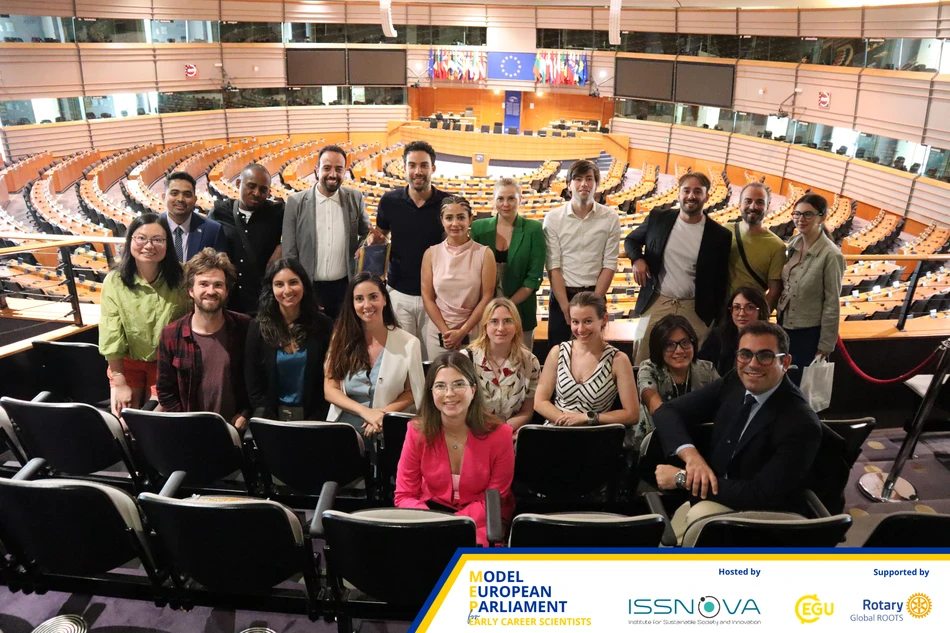
The MEP4ECS group visiting the EU Parliament hemicycle! Photo credit: Maria Vittoria Gargiulo, Marcello Andria and Nazimul Islam
More information
The European Geosciences Union (EGU) is Europe’s premier geosciences union, dedicated to the pursuit of excellence in the Earth, planetary, and space sciences for the benefit of humanity, worldwide. We are a non-profit, interdisciplinary, learned association of scientists founded in 2002, with headquarters in Munich, Germany. The EGU publishes a collection of diverse scientific journals, which use an innovative, interactive and open access format, and organises a number of events, meetings and outreach and education activities. The annual EGU General Assembly is the largest and most prominent European geoscience event, attracting over 20,000 researchers from all over the world. The EGU Special Activity Fund is a competitive fund launched in 2025 to support high-profile, ‘out-of-the-box’ not-for-profit activities with high visibility and large impact, that were not currently covered by any existing EGU funding. For more information, visit www.egu.eu.